To download the infographic click here.
Occupational Noise Exposure and Hearing Loss
Occupational noise exposure and noise-induced hearing loss (NIHL) are significant problems in some jobs around the world.
One third of the European workforce is exposed to elevated noise levels in the workplace 25% of the time.
Hearing loss caused by hazardous noise affects approximately 5% of the global population, which is about 380 million people.
Why is Compatibility Between PPE Important?
For hearing protection devices (HPD) to provide adequate protection, they must fit well and be comfortable to wear throughout an entire work shift. Numerous activities require the use of hearing protection devices along with other personal protective equipment (PPE), such as safety glasses. If they are not compatible, this can affect protection.
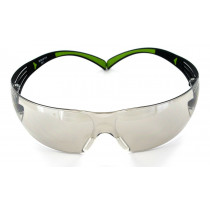
When PPE overlaps, how can we help minimize points of interference? A flexible and flat temple design can help minimize interference. That’s why it’s so important to choose safety glasses that are compatible with your hearing protection.
Can safety glasses affect the sealing of earmuff cushions? Yes. And without a good seal, outside noise can penetrate the hearing protection.
PPE Compatibility:
Measurements of personalized attenuation rating (PAR) were taken with the dual-ear validation system 3M™ E-A-Rfit™ and were used to assess attenuation levels. The personalized attenuation rating is obtained through a fit test of the hearing protector that measures the amount of noise reduction, or attenuation, of a selected hearing protection device when used by a particular individual.
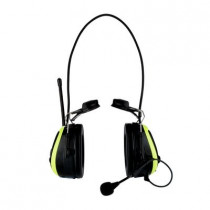
30 volunteers (with a wide variety of head and face sizes) underwent hearing protection fit tests while wearing different styles of safety glasses 3M™ in combination with various earmuffs 3M™ PELTOR™ (headband and mounted models). Each volunteer tested 42 combinations (which extend to 160 possible combinations) of earmuffs with and without safety glasses in random order.
Tested Product Lines
The safety glasses, earmuffs, and helmets that were tested represent additional models of PPE from 3M. For more details, download the full study.

Read the full study to see which specific models were evaluated.
Results
The results showed a reduction in PAR of 2 dB to 9 dB depending on the product combinations, based on approximately 1300 measured PAR values. All combinations of earmuffs and glasses showed a decrease in PAR compared to earmuffs alone. The decrease in PAR values indicated a loss of attenuation:
85% of the combinations tested lost attenuation of 6 dB or less.
48% ≤3 dB.
37% 4–6 dB.
15% 7–9 dB.
Highlights
≤3 dB: 48% of the combinations of safety glasses 3M™ SecureFit™ with earmuffs 3M™ PELTOR™ showed a lower loss of attenuation (≤3 dB) than other combinations.
These eye protection products feature exclusive Pressure Diffusion Temple 3M™ technology
- Flat and flexible temple design
- Minimizes interference with the sealing of earmuff cushions.
4 dB–9 dB: Other combinations show a greater loss of attenuation (4 dB-9 dB).
Some of these eye protection products feature leading-edge technology, providing more comfort, better fit, and higher performance, and may be the optimal product choice depending on specific hazards and environments.
- Lens tilt ratchet
- Anti-fog protective coating 3M™ Scotchgard™
- Retaining cord control system
- Foam gasket
Select the right combination for integrated protection:

Conclusions
Conduct the fit test while the user is wearing earmuffs and safety glasses at the same time and compare the PAR with the user’s noise exposure in the workplace.
If the PAR is sufficient, the result will be lower than the exposure limit target. If the PAR is insufficient, this means that other options should be tested to achieve more attenuation.
The key is to select a combination of products that offers adequate hearing and eye protection to meet the needs of your workers. You can use the table above to estimate the loss of attenuation as a guide to assess the suitability of the desired combination for the noise exposure environment.
To achieve minimal attenuation loss, choose safety glasses with flat and flexible temples, such as the safety glasses 3M™ SecureFit™.
 English GB
 Español
  Français
  Deutsch
  Italiano
  Português PT