The management of safety in industrial environments requires rigorous control of the state of Personal Protective Equipment (PPE). It is not enough to acquire high-end equipment and distribute it among the workforce; mechanical degradation, chemical exposure, daily use, and the simple passage of time diminish the structural capabilities of safety components. An omission in control deadlines can turn a rescue device into a critical risk.
To effectively structure an internal prevention policy, it is necessary to align corporate schedules with the requirements of the European and Spanish regulatory framework. The industrial inspection regulations leave no room for subjective interpretation: they establish unavoidable maximum deadlines based on risk categorization.
In this technical guide from Sekureco.eu, we delve into the legal and technical periodicity for the review of PPE, the applicable regulations, and the operational protocols essential to ensure regulatory compliance and the integrity of workers.
Introduction: the preventive life cycle of protective equipment
The life cycle of PPE is not a continuous straight line that ends abruptly with a visible break. It is a dynamic process of wear that is imperceptible to the naked eye. Factors such as material fatigue from continuous bending, invisible exposure to ultraviolet radiation, and contamination from environmental chemical agents gradually reduce the impact absorption capacity or tensile strength of the equipment.
Establishing a system of predictive preventive maintenance allows for the removal of safety components just before they cross the critical failure threshold, protecting the legal responsibility of the company and the life of the worker.
Technical explanation: review deadlines according to European regulations
Regulation (EU) 2016/425 classifies PPE into three categories based on the severity of the risk they protect against. The periodicity of mandatory technical reviews becomes stricter as the lethality of the hazard increases.
A. Category III Equipment (Fatal Risk): The 12-Month Rule
Category III equipment protects against risks that can have very serious consequences, such as death or irreversible health damage. For these components, European regulations establish that they must undergo a thorough review at least every 12 months.
Fall protection systems and standard EN 365
Fall protection systems (harnesses, portable lifelines, energy absorbers, and connectors) are strictly regulated by standard EN 365, which dictates the general provisions for usage instructions, maintenance, periodic review, repair, marking, and packaging.
Directive of EN 365: The standard explicitly requires that Category III PPE against falls from height be examined by a competent person authorized by the manufacturer, strictly following their inspection procedures, with a maximum frequency of one year. This deadline must be shortened if the conditions of use on-site are severe (marine environments, foundries, or handling acids).
Respiratory protective equipment (RPE) and air lines
Full masks, half masks, and self-contained equipment (EN 136, EN 140, EN 137) follow very rigorous annual inspection guidelines. In the case of respiratory protective equipment with air supply or high-efficiency filters, the annual review must include pneumatic tightness tests, verification of exhalation valves, and monitoring of the degradation of facial sealing elastomers.
B. Daily visual inspection vs. mandatory annual review by a competent technician
It is essential to legally and technically differentiate these two levels of control:
-
Daily visual inspection (Pre-use): is performed by the worker themselves before each workday. It is a quick macroscopic examination to detect obvious anomalies (frayed seams, deformations in metals, cuts in screens, or obvious saturation of filters).
-
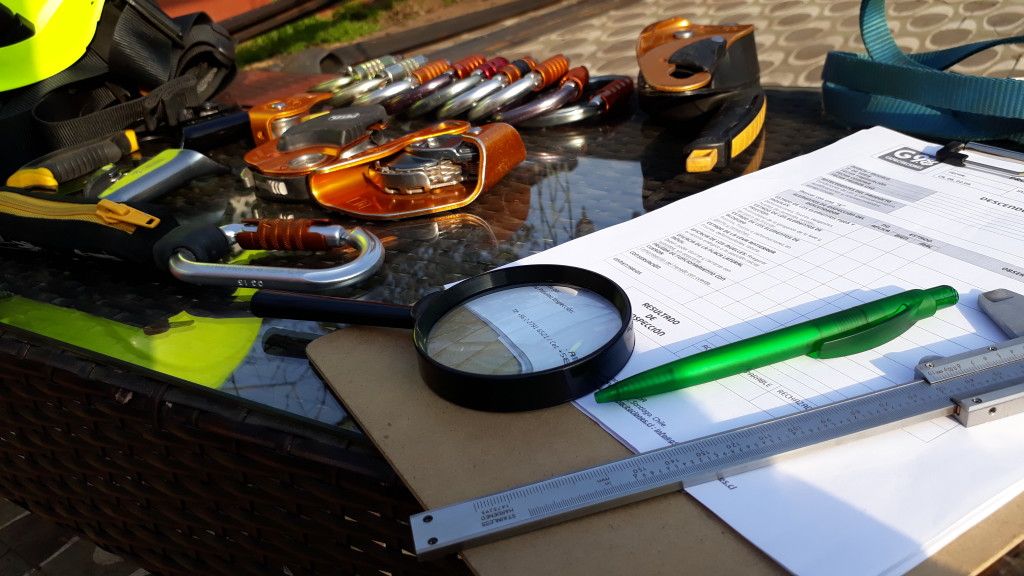
Periodic annual review: is a thorough technical examination conducted by a competent person. This specialist must disassemble components if necessary, measure wear with gauges, verify hidden impact indicators, and issue a binding opinion of "Fit" or "Not Fit".
C. Technical record: the maintenance and traceability log of the PPE
Each mandatory annual review must be recorded unequivocally in a maintenance control sheet or PPE logbook. This technical document, required during any labor inspection or ISO 45001 audit, must contain the following mandatory information:
-
Unique identification code of the equipment (Serial number).
-
Date of manufacture and date of commissioning.
-
Name of the manufacturer, model, and production batch.
-
Inspection history (Date, name of the competent technician, and result).
-
Next mandatory review date.

When to use each technical review protocol?
The dynamism of industrial activity requires the application of different inspection protocols depending on the operational moment in which the equipment is located.
Protocol before each use (worker's checklist)
This protocol is activated at the beginning of each shift. The worker must fill out or mentally verify a list of critical points according to the equipment. For example, in a cut-resistant or welding harness, it should be checked that the automatic click-lock buckles open and close without resistance, and that the dorsal and sternum D-rings do not show any play or cracks.
Extraordinary post-event protocol (falls, impacts, or chemical exposure)
This protocol overrides any annual review schedule. It must be activated immediately and irrevocably if the equipment has undergone a stressful event, such as:
-
Having stopped a real fall from height (even if the absorber appears intact).
-
Having received a severe mechanical impact (a safety helmet EN 397 on which a tool falls from height).
-
Having suffered an accidental splash of solvents, concentrated acids, or molten metals.
The PPE involved in a post-event protocol must be immediately withdrawn from circulation, labeled as "OUT OF SERVICE," and destroyed or sent to the manufacturer's official technical service for a final assessment.
Examples of products and management tools at Sekureco.eu
At Sekureco.eu, we not only supply certified equipment from leading brands in the market, but we also provide the technical tools necessary to facilitate the control of its life cycle.
Fall protection harness Sekureco EN 361 with impact indicator
To simplify daily visual inspections and annual reviews, we distribute advanced technical harnesses that incorporate mechanical fall indicators. These indicators consist of hidden safety seams of contrasting color (usually red) located on the back straps. If the harness stops a fall, the seam deliberately tears, revealing the alert indicator. This indicates to the prevention technician that the harness must be discarded without the need for laboratory tensile tests.
Software and inspection marking labels for lifelines
We offer physical marking systems using high-strength polyurethane inspection labels (type Scafftag), resistant to weather and chemical abrasion. These labels are securely anchored to the equipment's attachment point and visually display the exact date of the last review and the expiration of the next one. It is the fastest and most visual way to prevent a worker from mistakenly using equipment with an expired annual inspection.
Frequently asked questions about the periodicity of PPE reviews and industrial inspection regulations
Who is legally authorized to perform the annual review of a Category III harness?
The periodic review of Category III equipment under standard EN 365 must be carried out by a competent person. This figure is defined as someone who possesses in-depth knowledge of the manufacturer's procedures, has received specific training certified by the manufacturer or an authorized distributor, and has the necessary measuring tools to issue an official suitability report. A common worker or a company resource without specific manufacturer training is not legally qualified to sign such a review.
What penalty applies if a company does not have the PPE inspection record up to date?
The lack of record of mandatory PPE reviews (especially Category III) constitutes a serious or very serious infringement under the Law on Infringements and Sanctions in the Social Order (LISOS) in Spain, resulting in economic sanctions that can range from thousands of euros to the immediate suspension of work at height or in confined spaces, in addition to incurring direct criminal liabilities for managers in the event of a workplace accident.
Is the annual review of an EN 397 helmet legally mandatory?
Unlike Category III harnesses (EN 361), standard industrial helmets under EN 397 are usually classified as Category II. Legally, the obligation for a formal annual review strictly depends on the manufacturer's instruction manual. However, technical prevention guidelines recommend an annual technical examination and set its absolute expiration date between 3 and 5 years from the date of manufacture, due to the natural degradation suffered by polymers (HDPE or ABS) from sunlight and industrial thermal changes.
 English GB
 Español
  Français
  Deutsch
  Italiano
  Português PT