 English GB
 Español
  Français
  Deutsch
  Italiano
  Português PT




Mandatory PPE in industry: Basic equipment according to the labor sector.

In the industrial environment, safety regarding the use of Personal Protective Equipment (PPE) is a top legal and operational requirement. These equipment constitute the last line of defense for workers against environmental, mechanical, and chemical risks present in production and manufacturing plants. Therefore, a proper selection and implementation of these equipment not only ensures business continuity but also saves lives.
In this technical article from Sekureco.eu, we analyze in depth the European regulatory framework, the risk control hierarchy, and the mandatory protection matrix that must govern any manufacturing environment.
To optimize prevention in the plant, safety managers must structure the provision of equipment based on harmonized European standards (EN). This ensures that each PPE responds with mathematical precision to the specific risk of the work sector, whether it be automotive, steel, chemical, or logistics.
Introduction: Basic legal compliance in the manufacturing and industrial environment
The current manufacturing environment demands a work ecosystem where occupational risks are meticulously controlled. A failure to comply or ignoring the obligation of these equipment not only exposes workers to serious accidents but also places the company at risk of severe administrative, civil, and criminal penalties.
In Spain and the European Union, basic compliance indicates that the employer is obliged to assess the risks of each position and to provide the appropriate PPE free of charge, ensuring their perfect operational condition, maintenance, and the necessary technical training for their use.
Technical explanation: The risk control hierarchy and the European legal framework
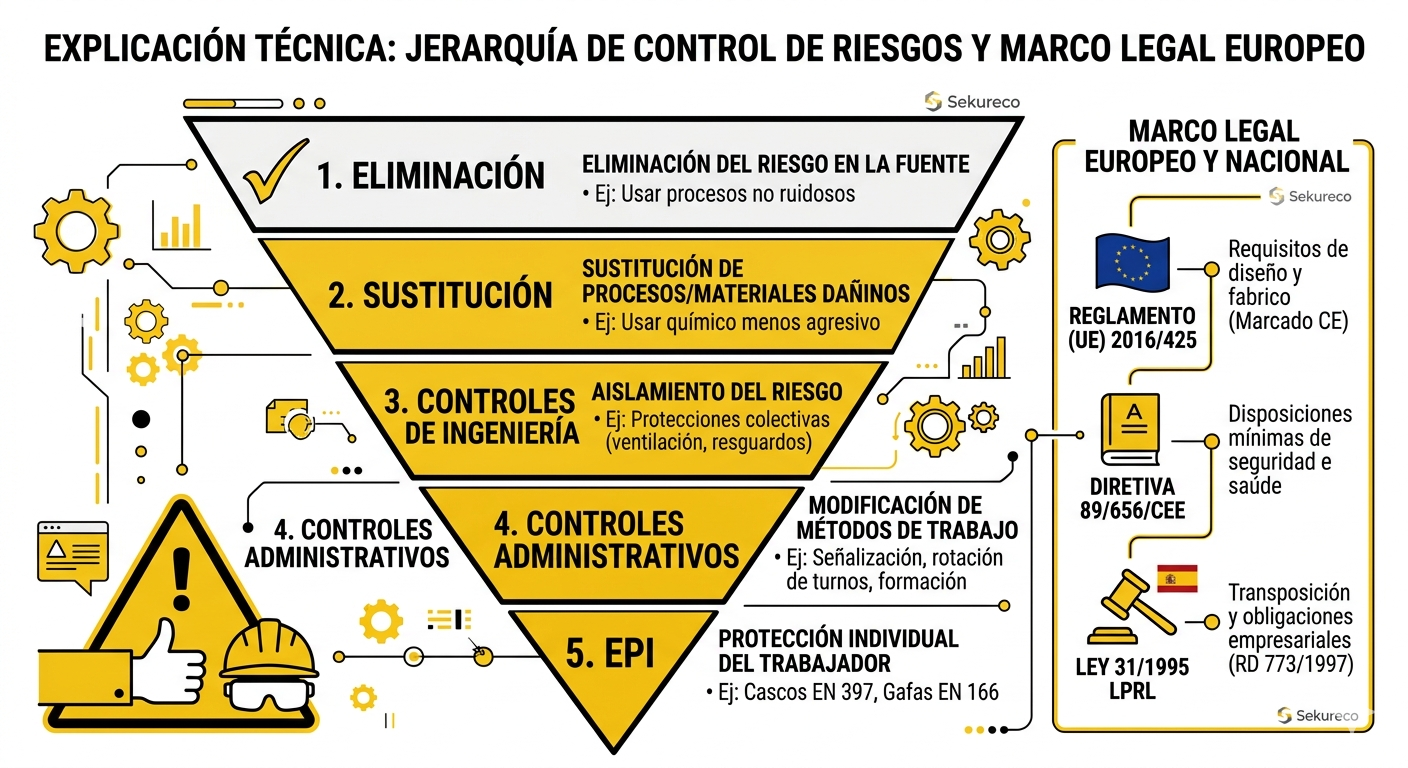
In safety engineering, providing PPE is always the last option. Before equipping a worker, the prevention department must strictly apply the Risk Control Hierarchy structured as follows:
-
Elimination: Completely remove the hazard from the operational environment.
-
Substitution: Replace the hazardous process or material with one of lower risk.
-
Engineering Controls: Isolate the risk through collective protections (extractors, machine guards).
-
Administrative Controls: Modify work methods (signage, shift rotation).
-
PPE: Protect the individual when the residual risk cannot be eliminated by the previous methods.
The role of EU Directives and the Occupational Risk Prevention Law
The legal framework rests on the Regulation (EU) 2016/425, which regulates the marketing conditions and essential safety requirements for the CE marking of PPE, and the Law 31/1995 on Occupational Risk Prevention (LPRL) along with the Royal Decree 773/1997. This regulatory set transposes community directives and establishes that PPE must be used when risks cannot be avoided or sufficiently limited by means of collective technical protection.
Mandatory PPE: Basic protection matrix in production environments
Below is the technical configuration of the minimum protection matrix that must be implemented in an active industrial plant:
Head protection (helmets EN 397)
The use of industrial safety helmets under the standard EN 397 is mandatory in any area where there is a risk of falling objects, impacts against fixed elements, or projections of materials. These helmets are specifically designed to absorb the energy of an impact through the partial deformation of the shell and the inner harness, protecting against severe cervical and cranial injuries.
Eye and face protection (safety glasses EN 166)
The standard EN 166 regulates the mandatory eye protectors in machining, welding, chemical handling, or cutting tasks, where there is a risk of projection of solid particles, fine dust, or liquid splashes. The optical class (Class 1 for continuous use) must be verified, and the corresponding radiological protection filters (UV, solar, or infrared) must be incorporated according to the position.
Hearing protection (earplugs and earmuffs EN 352)
When engineering measures fail to reduce ambient noise below critical thresholds, the standard EN 352 comes into play. The use of earplugs or earmuffs is legally mandatory if the daily noise exposure level exceeds 85 dB(A). The selection of the equipment must be calculated according to the overall attenuation index (SNR), ensuring that the effective noise reaching the inner ear is within a safe range of between 70 and 75 dB(A).
Industrial safety footwear (new EN ISO 20345:2022)
Footwear is a critical protective component in the industry. The recent update of the standard EN ISO 20345:2022 redefines the safety classes and slip resistance tests. It is mandatory to use footwear with protective toecaps capable of withstanding an impact energy of 200 J and a compression force of 15 kN in any industrial environment with a risk of falling heavy objects, entrapments, or punctures in the sole of the foot.
When is it mandatory to transition from basic PPE to Category III?
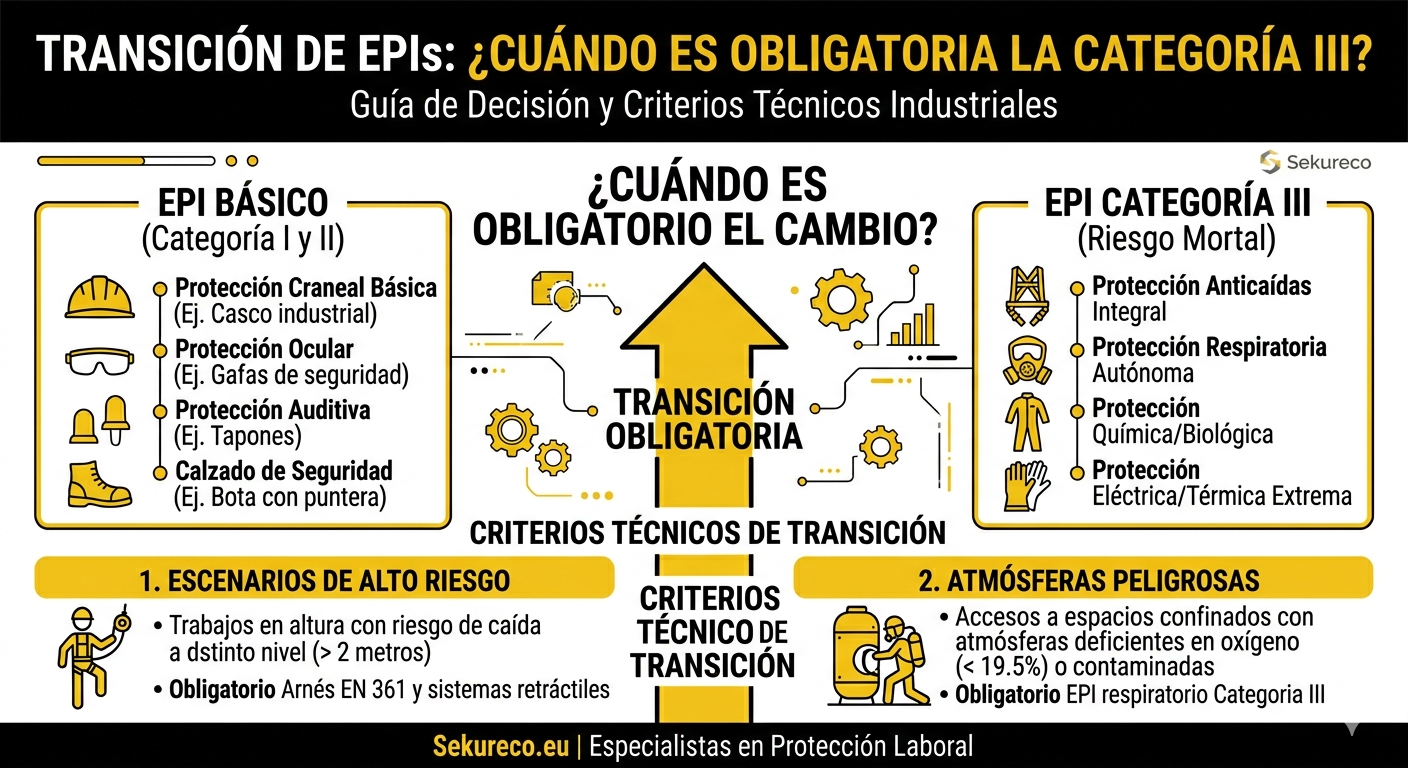
The basic matrix protects against moderate or mild risks (Category I and II). However, in scenarios of mortal danger or irreversible health damage, European regulations require a transition to Category III equipment.
Work at height with a risk of falling to a different level ( meters)
From a potential fall height of 2 meters, individual protections must necessarily transition to certified fall protection systems. This implies replacing conventional work clothing with a fall arrest harness (EN 361), connected to an anchor point using energy-absorbing lanyards (EN 355) or retractable fall arrest devices (EN 360).
Access to confined spaces with hazardous or oxygen-deficient atmospheres
Entering tanks, silos, reactors, or industrial sewer systems poses risks of asphyxiation or lethal poisoning. In these environments, where the oxygen concentration is below 19,5% or there are toxic gases, the use of Category III Respiratory Protection Equipment (RPE) is mandatory, such as full-face masks (EN 136) with combined high-efficiency filters (EN 14387) or self-contained breathing apparatus with air lines.
Examples of mandatory industrial supply products at Sekureco
At Sekureco.eu, we provide the industry with ranges of technical protection that best balance strict regulatory compliance with the ergonomic comfort of workers.
Panoramic safety glasses certified under the standard EN 166
We have panoramic eye protection glasses certified under the standard EN 166, equipped with polycarbonate lenses with high resistance to impact from high-speed particles. Their main industrial value lies in the incorporation of advanced perimeter sealing treatments against dust and certified anti-fog (N) and anti-scratch (K) coatings, ensuring clear visibility in high-sweat processes or sudden temperature changes in foundries and assembly plants.
S3S safety footwear with lightweight composite toecap and anti-perforation insole
Within the new framework of EN ISO 20345:2022, we distribute boots and safety shoes with certification S3S. These equipment replace traditional steel with high-resistance non-metallic composite toecaps and high-tenacity textile anti-perforation insoles. The result is magnetic footwear, extremely lightweight, with maximum energy absorption in the heel and improved waterproofing, ideal for workers who perform intensive shifts on concrete industrial floors.
Frequently asked questions about mandatory PPE in the industry according to the work sector
Can a worker refuse to wear safety glasses if they use their own prescription glasses?
No. Conventional street prescription glasses are not certified under the EN 166 standard; their lenses do not withstand industrial mechanical impacts and lack peripheral and lateral protection against impacts or chemical splashes. The worker is obliged to use the company's PPE. Legal technical solutions are: the use of protective overglasses mounted over their optical glasses, or the company providing properly graduated and certified single-vision or progressive safety glasses under the EN 166 standard.
What level of hearing protection (SNR) is mandatory if the noise in the plant exceeds 85 dB(A)?
The SNR attenuation level of the hearing protector must be sufficient to keep the effective acoustic pressure level within the worker's ear below 80 dB(A). For example, if a press area generates continuous noise of 102 dB(A), a protector with a minimum SNR of 25 dB should be selected (). It is essential to avoid overprotection: reducing noise below 60 dB(A) isolates the worker, preventing them from hearing forklift alarms or warnings from colleagues.
When is it mandatory to replace the bump cap EN 812 with an industrial helmet EN 397?
Replacement is mandatory when the risk changes from "hitting the head against stationary objects" to "risk of being struck by falling objects or vertical projections." Bump caps (EN 812) only protect against superficial abrasions in confined spaces or low assembly lines. If there are suspended loads, cranes, scaffolding, or work at different levels above the worker's head, the law strictly requires the use of a certified industrial safety helmet under the EN 397 standard.
Optimize your PPE Matrix with Sekureco.eu
Ensuring that 100% of your company's supply complies with European regulations and updates such as EN ISO 20345:2022 is a task of high technical responsibility. At Sekureco.eu, we specialize in industrial supply and preventive advice.
Access our Complete Catalog of Safety Footwear or consult us to audit the mandatory PPE needs in your production plants.