If your company outsources the washing of work clothes to an industrial laundry, or manages a textile rental service, it is very likely that you are assuming something that is not always true: that your flame-resistant (FR) or high-visibility garments will continue to fulfill their function after dozens of high-temperature washes.
The reality is that not all protective clothing is designed to withstand industrial washing. Domestic washing and industrial washing are completely different: different temperatures, different detergents, different mechanical forces, and different drying processes. A flame-resistant garment that loses its flame retardant properties after a few months of aggressive washing stops protecting exactly when it is needed the most, and many companies do not discover this until an inspection, a safety audit, or, in the worst case, a real incident.
In this article, we explain what makes a garment truly prepared for industrial washing, what standard regulates it, and how to choose the right clothing if your operations depend on an industrial laundry or a uniform rental service.
Protective clothing resistant to industrial washing: the technical side EN ISO 15797
The EN ISO 15797 ("Textiles - industrial washing and finishing procedures for the testing of workwear") is the European reference standard that defines how workwear - including, where applicable, PPE garments - should be tested against the washing and drying processes used in industrial laundries.
Unlike a domestic washing test, this standard simulates much more demanding conditions:
- High temperatures: usually between 60°C and 85°C, well above a conventional domestic wash.
- High mechanical load: large-capacity industrial washing machines exert much greater force on the fabric than a domestic washing machine.
- Specific chemical products: detergents, alkaline agents, and, in some processes, bleaching agents calibrated for bulk use, not for delicate treatment.
- Tunnel or drum drying at high temperatures: industrial drying processes (tunnel finishing) can reach temperatures of over 140°C on the fabric.
- Up to 8 washing programs and 2 drying methods defined by the standard, from which the manufacturer selects the most suitable according to the fabric composition.
The objective of these tests is to verify properties such as dimensional stability (that the garment does not shrink or deform), color fastness, seam condition, pilling (formation of pills on the fabric), and, in the case of garments certified as PPE, that the protective properties remain intact after the number of washing cycles indicated by the manufacturer.
This last point is the most critical from a workplace safety perspective: a flame-resistant jacket may have, for example, a maximum number of certified industrial washes (usually indicated on the garment label through a counting system, sometimes with an electronic chip in advanced laundries). Exceeding that number of cycles without replacing the garment means, in practice, continuing to work with PPE that no longer guarantees the level of protection for which it was certified, even if it visually appears to be in good condition.
WHEN IS CERTIFIED CLOTHING FOR INDUSTRIAL WASHING REQUIRED?
This category of product is essential in any operation where work clothing is washed regularly in an industrial laundry or through a textile rental service, including:
- Petrochemical and offshore industry, where flame-resistant (FR) clothing is washed frequently and must maintain its EN ISO 11612 / EN ISO 11611 certification throughout its useful life.
- Food industry, with hygiene protocols that require frequent high-temperature washes.
- Hospitality and large facilities, where uniforms are usually managed through external textile rental services.
- Healthcare and sectors with strict hygiene requirements, where industrial washing is the norm, not the exception.
- Companies with fleets of high-visibility PPE, where losing certification after several washes poses a real risk in environments with vehicle or machinery traffic.
- Any company that outsources the laundry of its work clothing, without having verified whether the garments are specifically certified for that process.
If your company falls into any of these cases, the purchasing criterion should not be solely "flame-resistant clothing" or "high-visibility clothing," but specifically clothing certified for industrial washing according to EN ISO 15797, with the maximum number of washing cycles indicated by the manufacturer.
CERTIFIED SOLUTIONS AVAILABLE AT SEKURECO
Within our category of industrial washing clothing, here are some references already available specifically designed to withstand industrial laundry processes without losing their protective certification:
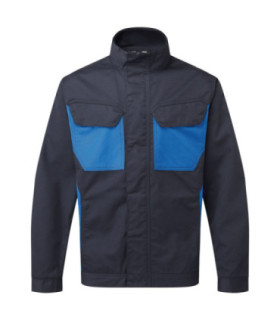
Portwest FR68 — Bizflame Ultra Jacket: special blend of FR polyester, withstands industrial washing at 75°C and tunnel drying at 155°C. Certified EN ISO 11612, EN ISO 11611 Class 1, and EN 1149-5 (antistatic), with protection against molten metal splashes and fabric with UV protection factor 40+.
Portwest FR55 - Bizflame Plus Jacket: protection against radiant, convective, and contact heat, with Class 2 welding protection. Domestic use limited to 60°C, but prepared for a defined maximum number of industrial washing cycles before requiring replacement.
Portwest FR25 - Bizflame Plus High Visibility Jacket: combines flame retardancy with double-stitched high-visibility reflective tapes, with flame resistance guaranteed throughout the garment's useful life according to the manufacturer.
Portwest FR08RER - Bizflame Industry Bicolor Jacket: designed for demanding working conditions in offshore or construction sites, with flame-resistant industrial washing tape sewn in and CE Category III certification.
Best-selling washable industrial garments from Portwest
Portwest FR750 - Bizflame Industry FR Jacket: withstands industrial washing at 75°C and tunnel drying at 155°C, with protection against radiant, convective, and contact heat. Features Velcro cuffs for a secure fit and an external label for quick identification of certified protection levels.

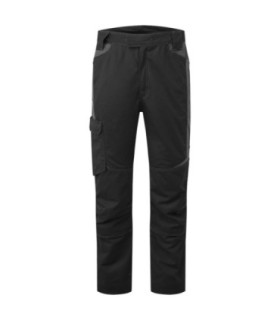
Bizflame Industrial FR Pants PORTWEST FR454 specialized garment for working in hazardous conditions, designed for industrial washing and drying, and also suitable for domestic care, offering durable performance, reliability, and comfort.

Bizflame Industrial FR Bib and Brace PORTWEST FR455: a professional garment that features a special blend of flame-resistant polyester. The model is designed for industrial washing and drying, and also suitable for domestic care, offering durable performance, reliability, and comfort.

Bizflame Industrial FR Coverall PORTWEST FR529: suitable for industrial washing at 75°C and tunnel drying at 155°C. This coverall is designed to work in hazardous conditions, both offshore and on land, combining style and high performance.

FREQUENTLY ASKED QUESTIONS
What is the difference between industrial washing and domestic washing for protective clothing?
Industrial washing uses higher temperatures, greater mechanical force, and specific chemical products in bulk, while domestic washing is much gentler. A garment not certified for industrial washing may lose its protective properties much faster if washed in that environment.
How do I know how many industrial washes a garment can withstand?
The manufacturer indicates the maximum number of certified industrial washing cycles, usually on the garment label. Some advanced industrial laundries use electronic counting systems (chips or RFID tags) to keep this control automatically.
Can I wash any flame-resistant clothing in an industrial laundry?
It is not recommended. If the garment is not specifically certified according to EN ISO 15797 for industrial washing, the process may degrade its protective properties more quickly than expected, without this being visible to the naked eye.
What if my laundry provider does not know the maximum number of washes for my garments?
It is a warning sign. An industrial laundry provider working with protective clothing should manage the lifecycle of each garment according to the manufacturer's instructions, not wash all textiles with the same generic process.
Does industrial washing certification also affect high visibility, not just flame resistance?
Yes. High-visibility reflective tapes can also degrade with aggressive washing processes if they are not designed for it, reducing their reflective capacity even if the garment still appears to be in good visual condition.
PROTECT YOUR TEAM THROUGHOUT THE ENTIRE LIFECYCLE OF THEIR WORK CLOTHING
Choosing protective clothing does not end at the time of purchase: its effectiveness also depends on how it is washed and maintained throughout its useful life. At Sekureco, you will find a range of garments specifically certified for industrial washing according to the EN ISO 15797 standard, designed for companies that manage their work clothing through industrial laundries or textile rental services.
Check out our category of protective clothing for industry and construction and ensure that your team remains protected wash after wash, not just on the first day.
 English GB
 Español
  Français
  Deutsch
  Italiano
  Português PT