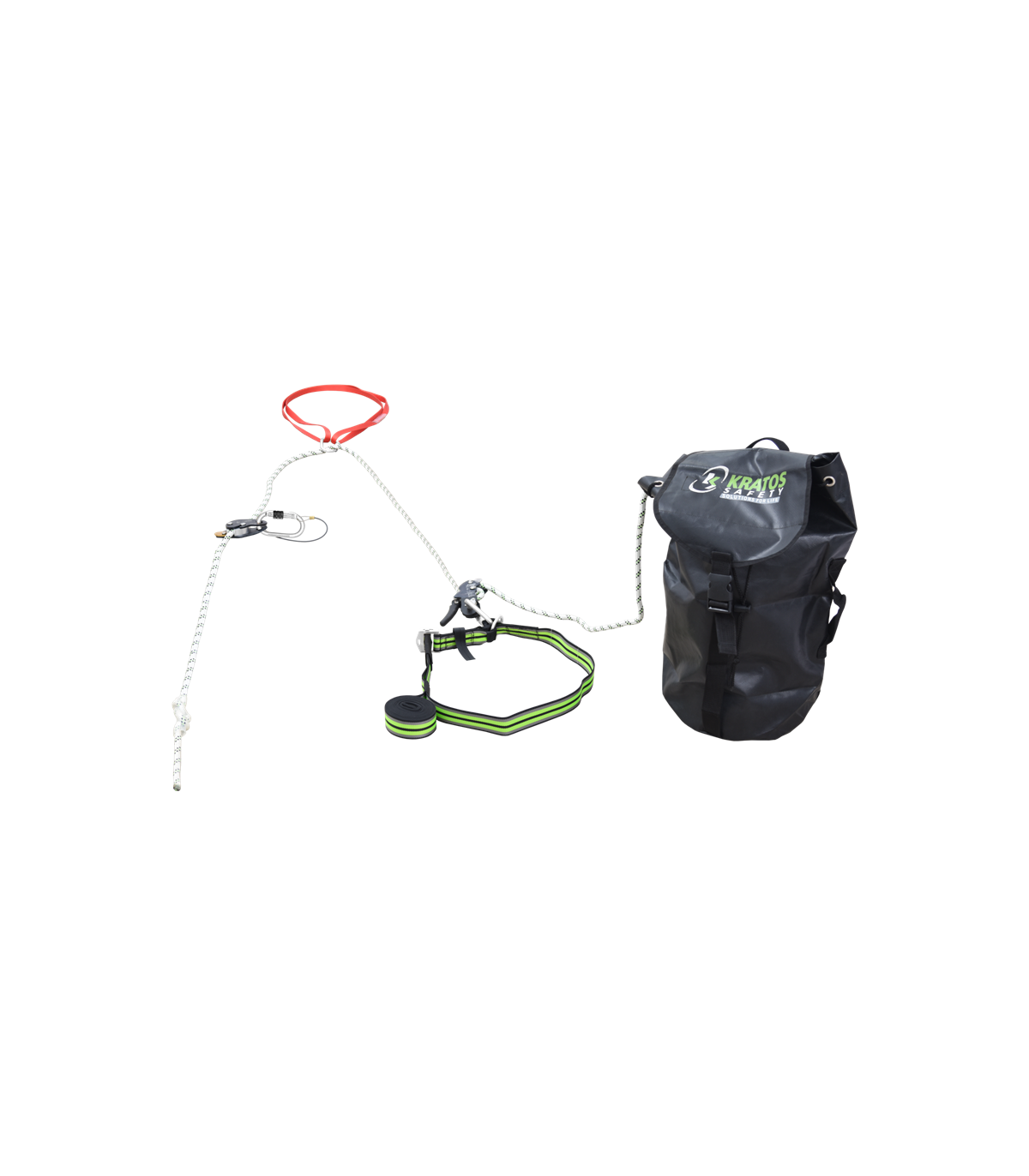
Fall protection system with integrated evacuation function - lg 30 m and 50 m KRATOS SAFETY. Sliding fall protection system on braided rope with built-in descender on the anchor point, allowing for the unlocking of the anchor point and the descent of the victim. This set allows for the anticipation of the rescue system even before the fall protection is installed. Equipped with different anchoring straps, this kit can be installed on a multitude of supports (ladder, pole, large structure...).
Fall protection kit for scaffolding with harness and anchor ring KRATOS SAFETY. The Comfort Kit for scaffolding KRATOS SAFETY is the ideal solution for professionals working at height. This kit, designed with the...
Anchor post with energy absorption system for steel sheet cover and resistance 26 kN KRATOS SAFETY. Its design allows for the dissipation of the energy generated by the stop of a fall. Made of stainless steel....
Anchor post with energy absorption system for standing seam roof and resistance 26 kN KRATOS SAFETY. Made of 316 stainless steel, it offers exceptional resistance to corrosion and atmospheric agents, ensuring a long...
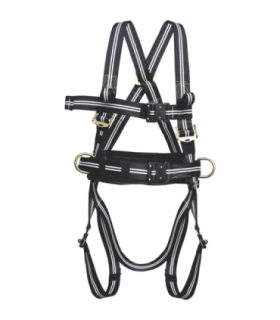
Harness with belt, fire-resistant, with splash-resistant straps for molten metal FIRE FREE KRATOS SAFETY. It has 1 D-ring on the back, 1 frontal attachment point formed by 2 textile buckles for fall protection system,...
Fall protection system with integrated evacuation function - lg. 30 m
Sliding fall protection system on braided rope with built-in descender on anchor point, allowing for the unlocking of the anchor point and the descent of the victim.
This set allows for the anticipation of the rescue system even before the fall protection is installed.
Equipped with different anchoring straps, this kit can be installed on a multitude of supports (ladder, post, large structure...).
FEATURES
One self-locking descender FA 70 021 00
One sliding fall protection on rope, multipurpose FA 20 103 00A
One anchoring support, lg. 30 m FA 20 103 30
One adjustable anchoring strap, max length 5 m FA 60 029 05
Two anchoring rings on strap, length of 1.50 m FA 60 005 15
Three steel connectors with automatic triple-action locking FA 50 301 23
One bag to store and transport everything FA 90 105 00
TECHNICAL DATA
PPE / NON PPE PPE
Additional Advantages Ready-to-use Kit
HS: 84798997
VIDEO
STANDARDS
- EN353-2: A sliding fall protection on flexible safety support is a device that automatically locks and immobilizes on the vertical support in case of user fall. The safety support can be made of cable or rope (braided or cord). These flexible supports must be stabilized with a counterweight. Breaking strength of these systems >15 kN.
- EN 795:2012: refers to anchoring systems, but in this case focuses on portable anchoring devices. These devices are designed to be used on the ground or on flat surfaces and do not require a fixed installation on a structure.
- EN 341:2011 refers to safety devices for the descent of people and focuses on braking systems used on ropes for rescue and evacuation. This standard establishes safety, performance, and testing method requirements for equipment used in activities such as working at height, rescues, and emergency situations. The main objective is to ensure that these devices are safe and effective, minimizing the risk of accidents during use.
USE
It will only be used in work that requires significant movement.
HOW TO CHOOSE
The choice of fall protection should be made based on the movements that need to be carried out. Obviously, when choosing the fall protection system, the position of the attachment point must be studied.
If the movement is purely vertical (along a ladder for example), a sliding fall protection on safety support should always be favored. They have the advantage of being able to be installed (some of them) permanently on the structure.
If the movements can be horizontal and vertical, an automatic retractable fall protection should be preferred. This is the fall protection that provides the greatest freedom of movement.
Sliding fall protections should always be used vertically from the anchor point.
Automatic retractable fall protections are particularly suitable for low-height work, as the locking is almost instantaneous, thus limiting the necessary free height.
For work on an inclined plane with a sliding fall protection, it is necessary for the fall protection to be equipped with a manual locking system.
APPLICATIONS
It can be used wherever the user needs great freedom of movement and has to navigate obstacles while remaining safe.
Fall protections on safety support are mainly used for the following professions:
Work on poles
Work on rock walls
Work on lifts
Window cleaner
Rope access technician
Rescuer
Roofer-waterproofing technician
Antenna and telecommunications technician
Automatic retractable fall protections will be used more for the following professions:
Facade work, on terraces, on scaffolding, on platforms, and in maintenance.
LABORATORY
Satra Technology Europe Ltd., N° 2777, Bracetown Business Park, Clonee, Dublin, D15YN2P, Ireland. SGS Fimko Oy, N° 0598 Takomotie 8, 00380 HELSINKI, Finland
THE FUNDAMENTAL PRINCIPLES OF RESCUE AND EVACUATION
When working at height, an accident may occur that requires the intervention of a rescue team to evacuate the victim.
In that case, the rescue team personnel must intervene in an emergency situation, and THE GOLDEN RULE in such cases is TO AVOID WORSENING THE ACCIDENT.
Therefore, before any intervention, the following questions should be asked:
Is there residual risk after the accident (electrical risk, presence of gas...)?
Do I have the capacity to intervene (from a physical, psychological, technical perspective...)?
Do I know the rescue plan (calling emergency services...) and the operational mode of evacuation?
Have I received SPECIFIC training in rescue operations that I should apply? (OBLIGATION of directive 89/655/EEC article 7 and annex II paragraph 4.4.f [directive 2001/45/EC]).
The rescue personnel can then intervene according to the previously defined rescue plan, and their priorities will be:
Secure the victim,
Remove the victim from the inert suspension situation as soon as possible,
Wait for help to arrive under the best possible conditions.
Each situation is unique and requires the appropriate material. When establishing an evacuation plan that defines the human and material means to be used, it is necessary to distinguish between the following situations:
evacuation in confined space,
self-evacuation in fixed position,
evacuation on the ground (multiple situations, one or several victims),
Kratos Safety le ofrece una solución anticaída completa con servicios de gama alta, orientados hacia el cliente. La gama Kratos Safety está diseñada para responder a los requisitos de las Normas europeas, así como las expectativas de confort y ergonomía de los usuarios en su puesto de trabajo.
 English GB
 Español
  Français
  Deutsch
  Italiano
  Português PT









@CUSTOMER_NAME@
@AUTHOR_PROFILE@ @COMMENT_ISO_COUNTRY@ @VERIFY_PURCHASE@@COMMENT_TITLE@
@COMMENT_COMMENT@