 English GB
 Español
  Français
  Deutsch
  Italiano
  Português PT




EN ISO 374: Everything you need to know about chemical protective gloves

In the industrial environment, exposure to chemical substances is a common and sometimes silent risk. For every worker/professional in the industry, it is vital to have accurate information about the risks and their types in their work environment. Likewise, for industries, it is crucial to stay updated regarding the European regulatory framework. The EN ISO 374 standard regulates and determines the effectiveness of protective gloves against hazardous chemicals and microorganisms.
Compliance with these standards is crucial to avoid contact with hazardous chemicals and microorganisms, providing a real and certified barrier. This prevents burns, allergic reactions, and absorption of toxic substances that occur at the molecular level.
What does the EN ISO 374 standard mean?
This regulation establishes performance requirements for gloves that protect against permeation (the passage of molecules through the material), degradation (physical deterioration), and penetration (the passage of chemicals through pores or defects).
To identify if a glove meets this standard, we should always look for the precipitate glass pictogram alongside the identifying letters of the chemicals against which it has been tested.
Classification of chemical gloves, according to protection levels: A, B, and C
The EN 374 standard divides gloves into three types based on their permeation time against at least 300 minutes (5 hours) of exposure to a standardized list of 18 chemicals:
-
Type A (high protection): resistance to permeation greater than 30 minutes against at least 6 chemicals from the list. Ideal for environments with intensive chemical handling.
-
Type B (medium protection): resistance to permeation greater than 30 minutes against at least 3 chemicals from the list.
-
Type C (low protection): resistance to permeation greater than 10 minutes against at least 1 chemical from the list.
The selection of the level of protection (Type A, B, or C) must strictly align with the risk analysis and the matrix of compatible polymers for each sector. Below are examples of key industries and how they apply these levels of protection:
-
Petrochemical industry and refineries (Type A Protection): in this sector, complex hydrocarbons, aggressive solvents like toluene (Letter F), and concentrated acids at high pressures are handled. For this, Type A gloves (with a minimum barrier of 30 minutes against 6 chemicals) made from materials like Viton or heavy nitrile compound are required, capable of resisting simultaneous mechanical and chemical degradation.
-
Pharmaceutical industry and clinical laboratories (Type B Protection / VIRUS Marking): in this type of sector, the priority is twofold: to protect the worker from reagents, alcohols, and bases, and to prevent biological cross-contamination. Type B gloves made of fine nitrile or neoprene are the standard, ensuring dexterity for handling vials and passing the viral penetration test ISO 16604 to block nanometric-sized pathogens.
-
Automotive industry and paint workshops (Type B Protection): during degreasing processes and application of two-layer paints, workers are exposed to mixtures of solvents and ketones. A Type B glove offers the perfect balance between localized chemical resistance against the components of the safety data sheet (SDS) and the necessary touch for high-precision finishes.
-
Industrial cleaning services and facility maintenance (Type C Protection): for handling diluted industrial detergents, everyday disinfectants, or low-concentration acidic solutions, a Type C glove (resistance >10 minutes against at least 1 chemical) is usually sufficient. It provides effective protection against incidental splashes in short-duration tasks without compromising the ergonomics of the worker.
Microorganisms: Beyond Chemicals
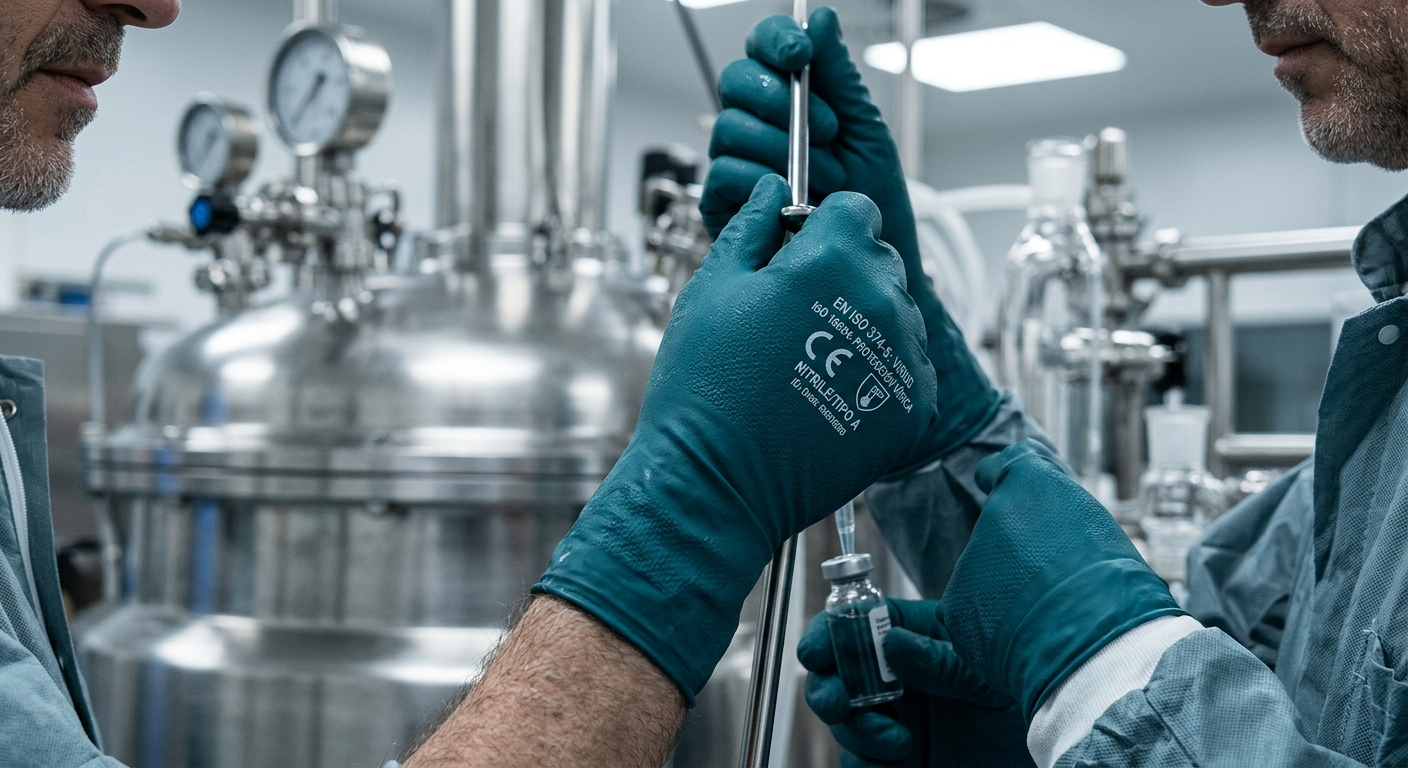
The standard also considers biological protection: a glove certified as "Protection against bacteria and fungi" must pass penetration tests. If the glove also offers protection against viruses, it must include the word "VIRUS" under the pictogram, indicating that the material has passed the viral penetration test ISO 16604.
Therefore, for environments with high exposure to biological risks, standard certification against microorganisms is not enough. Advanced protection against critical viruses is validated through the ISO 16604 test, which subjects the material to hydrostatic pressure using the bacteriophage Phi-X174 as a model organism. This test ensures that the protective barrier of the glove can block nanometric-sized pathogens, being the essential technical requirement for an PPE to bear the specific virus protection marking in the professional environment.
Criteria for choosing chemical gloves for your company
As specialists at Sekureco, we recommend following these steps before acquiring chemical gloves:
-
Consult the Safety Data Sheet (SDS): identify the CAS number of the chemical you are handling.
-
Verify polymer compatibility: Is the material (nitrile, neoprene, butyl) appropriate? A Type A glove may fail if the polymer is soluble against the specific chemical.
-
Periodic visual inspection: chemical gloves should not show signs of swelling or loss of flexibility.
Check out our varied collection of chemical protection gloves and make the most efficient choice for your company.

Frequently asked questions about chemical protection gloves
1. What does the "permeation" time of the EN 374 Standard mean?
It is the time it takes for a chemical substance to pass through the material of the protective glove at the molecular level. A longer permeation time offers greater safety to the worker.
2. Is a Type C glove sufficient to face industrial cleaning chemicals?
Generally yes, as long as the cleaning product is not highly aggressive. However, for handling concentrated acids or solvents, a Type A glove is mandatory.
3. How can I know if my gloves protect against viruses?
You must check that the word "VIRUS" explicitly appears under the microorganisms pictogram. If it is not listed, you are only protected against bacteria and fungi.
4. Can I reuse a chemical glove after washing it?
Only if the manufacturer indicates it as "reusable." Otherwise, they are considered single-use PPE. Improper reuse can cause the chemical to accumulate in seams or pores.
5. Does the EN ISO 374 standard guarantee protection against heat or cuts?
No. This standard focuses exclusively on chemical and biological risks. If the task involves mechanical risks, the glove must additionally have the EN 388 marking.