 English GB
 Español
  Français
  Deutsch
  Italiano
  Português PT




How to know if an PPE is certified according to European regulations? Complete verification guide.

Personal Protective Equipment (PPE) is the real barrier that protects workers from workplace accidents, so no improvisation is acceptable in terms of quality and legality. When a company acquires equipment without the proper European certification, it not only exposes itself to severe penalties under the Occupational Risk Prevention Law but also leaves the worker defenseless.
The current market is saturated with equipment that appears robust but lacks the necessary regulatory backing to be considered a certified PPE. In this technical guide, we teach you how to identify authentic PPE that complies with Regulation (EU) 2016/425.
What does a certified PPE really mean?
A certified PPE is one that has undergone rigorous evaluation processes to ensure it meets the "Essential Health and Safety Requirements" (EHSR) defined by the European Union. This certification guarantees that the equipment is effective for protection against the specific risk for which it was designed.
If equipment does not have this backing, it is not PPE; it is simply a garment or component without real protective capacity.
The 4 fundamental pillars to identify a certified PPE
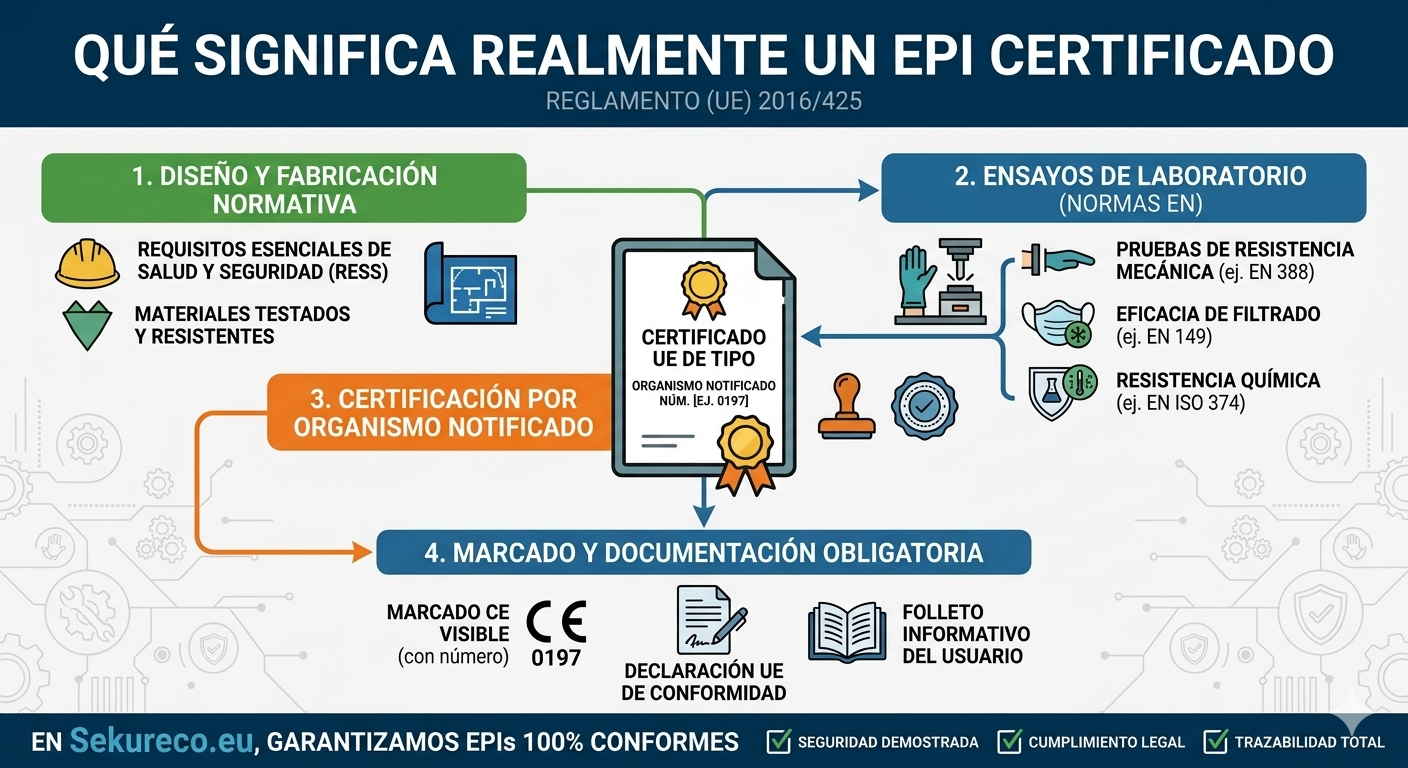
As specialists at Sekureco.eu, we have synthesized the four key elements for Occupational Risk Prevention managers or purchasing heads to verify before acquiring any equipment.
1. CE Marking: The first step in verification
The CE marking is visible on the product, packaging, or label. However, not all CE markings are the same.
-
In Category I: The manufacturer declares conformity.
-
In Category II and III: The CE marking must be accompanied by a 4-digit number (e.g., CE 0197). This number identifies the Notified Body that conducted the type examination and, in the case of Category III, the production surveillance. If you see a CE marking without a number on a complex risk PPE (Category III), be suspicious immediately.
2. EU Declaration of Conformity
A certified PPE must always have an EU Declaration of Conformity. This is a legal document that accompanies the equipment, where the manufacturer declares that the product complies with Regulation (EU) 2016/425.
If your supplier cannot provide you with this document, the equipment should not enter your warehouse. A professional PPE always has documented traceability.
3. Instructions for use (The information leaflet)
By law, every PPE must be accompanied by an information leaflet in the official language of the country where it is marketed. This document is vital because it contains:
-
The limitations of use.
-
Maintenance and cleaning instructions.
-
Reference to the EN standards met.
-
The expiration date or useful life of the equipment.
4. Pictograms and EN Standards (Technical Regulations)
A certified PPE is not defined solely by a mark but by compliance with a specific technical standard. For example:
-
EN 388: For mechanical protection gloves.
-
EN 397: For industrial safety helmets.
-
EN ISO 20345: For safety footwear. Verifying that the pictogram corresponds with the actual use of the worker is essential for regulatory compliance.
The danger of counterfeits in PPE: The myth of "China Export"
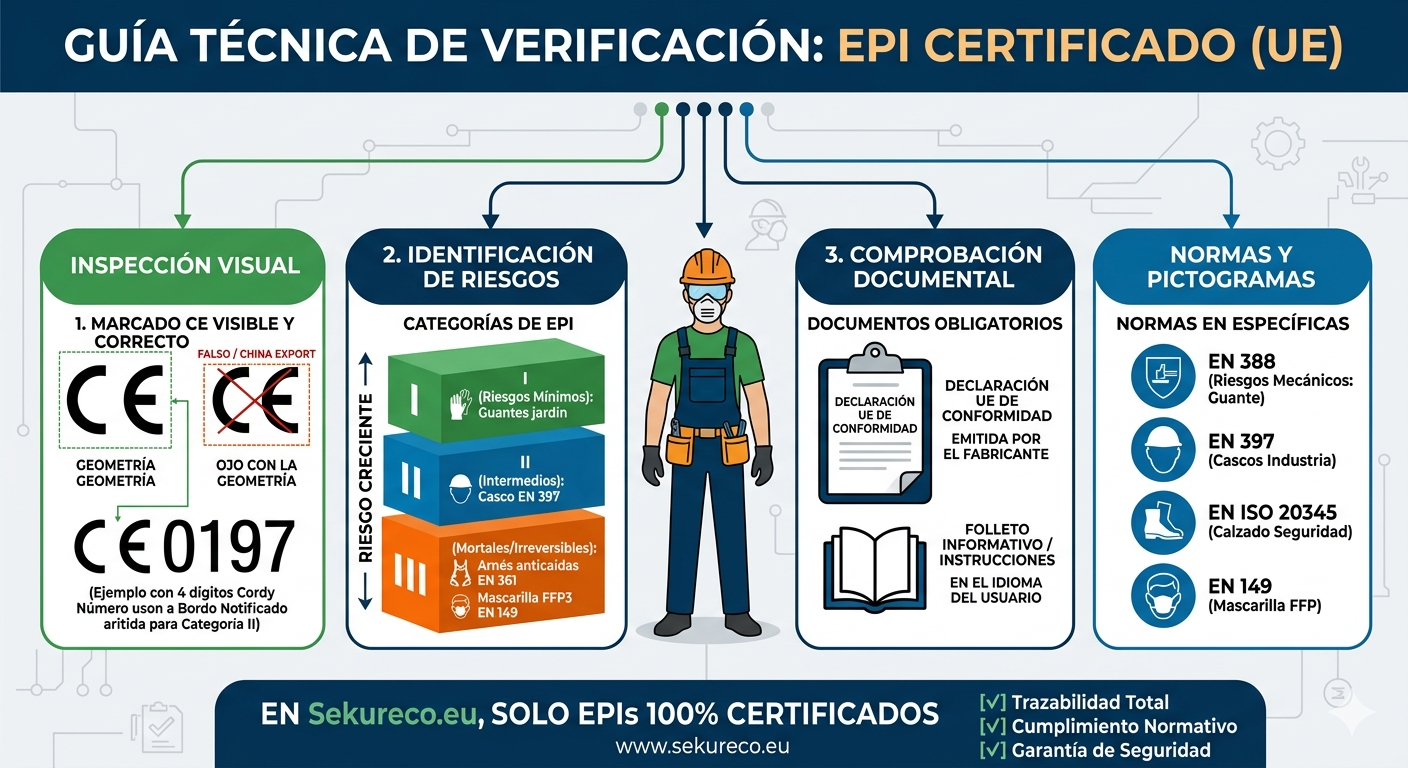
It is imperative to clarify a critical point: the existence of the "China Export" logo. There is a belief that it is a counterfeit, but in reality, it is often a visual confusion. The true CE logo has a specific geometry (the C and E are aligned in a particular way). If you notice that the CE marking on your equipment is blurry, irregular, or does not correspond to the legal proportions, you are likely facing equipment that has not passed the required laboratory tests to be considered a certified PPE.
Consequences of buying non-certified PPE
Purchasing "low-cost" or uncertified equipment carries risks that go far beyond the initial economic savings:
-
Criminal liability: In the event of an accident, if it is proven that the PPE used was not appropriate or lacked certification, the company and the safety officer may face criminal liabilities.
-
Technical ineffectiveness: A glove that does not comply with EN 388 may tear under a cut that, in theory, it should have resisted, causing severe injuries.
-
Penalties from the Labor Inspection: The lack of documentation (Declaration of Conformity) is a direct reason for administrative penalties.
Conclusion: The commitment to professional safety regarding PPE
Identifying a certified PPE is a technical rigor exercise that protects individuals and organizations. At Sekureco.eu, our priority is transparency; therefore, each product sheet includes the necessary regulatory information so that our clients can purchase with complete confidence.
Keep in mind that workplace safety is not an expense but an investment in the continuity of your business and the protection of workers.
Do you need to verify the technical documentation of any of your current equipment? At Sekureco.eu, we are experts in European regulatory compliance. Check our catalog or contact our technical team to ensure your company meets the highest standards.
Frequently asked questions about how to know if a PPE is certified
How to identify a certified PPE according to Regulation (EU) 2016/425?
To identify a certified PPE, you must verify the CE marking visible on the product. If it is a Category II or III PPE (intermediate or fatal risks), the CE marking must be accompanied by the 4-digit number of the Notified Body. Additionally, it must have its EU Declaration of Conformity and an information leaflet.
What is the EU Declaration of Conformity and why is it mandatory?
It is the legal document with which the manufacturer guarantees that the PPE meets the essential health and safety requirements of Regulation (EU) 2016/425. Without this document, the equipment lacks legal validity and should not be used in work environments, as its protective effectiveness cannot be demonstrated.
What is the difference between the CE marking and the "China Export" logo?
It is a common error of visual confusion. The authentic CE marking has a specific geometry where the 'C' and 'E' are aligned under precise legal criteria. The "China Export" logo, which often resembles it, does not guarantee any European conformity. If the marking is irregular, blurry, or the letters are poorly spaced, the equipment is not a certified PPE.
What legal consequences does using non-certified PPE have?
Using equipment without certification can lead to serious consequences, including administrative penalties from the Labor Inspection, criminal liabilities in the event of a workplace accident, and an unacceptable exposure of the worker to risk, as the equipment has not passed the required technical tests (EN standards).
Where can I find the applicable EN standards for my PPE?
The EN standards (such as EN 388 for mechanical risks or EN 149 for respiratory protection) must be clearly stated both on the product labeling and in the technical leaflet (instructions for use) that must accompany each PPE. At Sekureco, this information is detailed in each technical sheet to ensure transparency.