 English GB
 Español
  Français
  Deutsch
  Italiano
  Português PT




How to choose the right cut-resistant gloves? Key points for professional selection.

In the industrial sector, hand injuries continue to represent a critical percentage of workplace accidents. Therefore, in the field of occupational safety, choosing a cut-resistant glove is a vital decision that must be made based on the quality of this type of Personal Protective Equipment (PPE), and requires a thorough technical analysis of the risks, materials, and current European regulations.
Below, we offer you this comprehensive guide to selecting the ideal cut-resistant gloves for your team, ensuring maximum safety at work without sacrificing productivity or ergonomics.
Introduction to cut protection for hands
Cut protection has undergone a technological revolution in the last decade. Gone are the days when a thick leather glove was the only option for protecting hands. Today, technical fabrics allow for high levels of resistance with minimal thickness, resulting in greater touch sensitivity and comfort for the worker.
However, this variety of options generates a common question in risk prevention departments: How to choose the right glove among so many fibers and coatings? The technical answer lies in cross-referencing the company's risk assessment data with the manufacturer's certifications under the European regulatory framework.
Technical explanation: fibers, coatings, and regulations of cut-resistant gloves
To choose correctly, it is essential to understand the physics of the glove: what it is made of (textile support) and how it interacts with the work environment (coating).
1. Technical fibers
The intrinsic resistance to cutting is determined by the threads used in the glove's fabric:
-
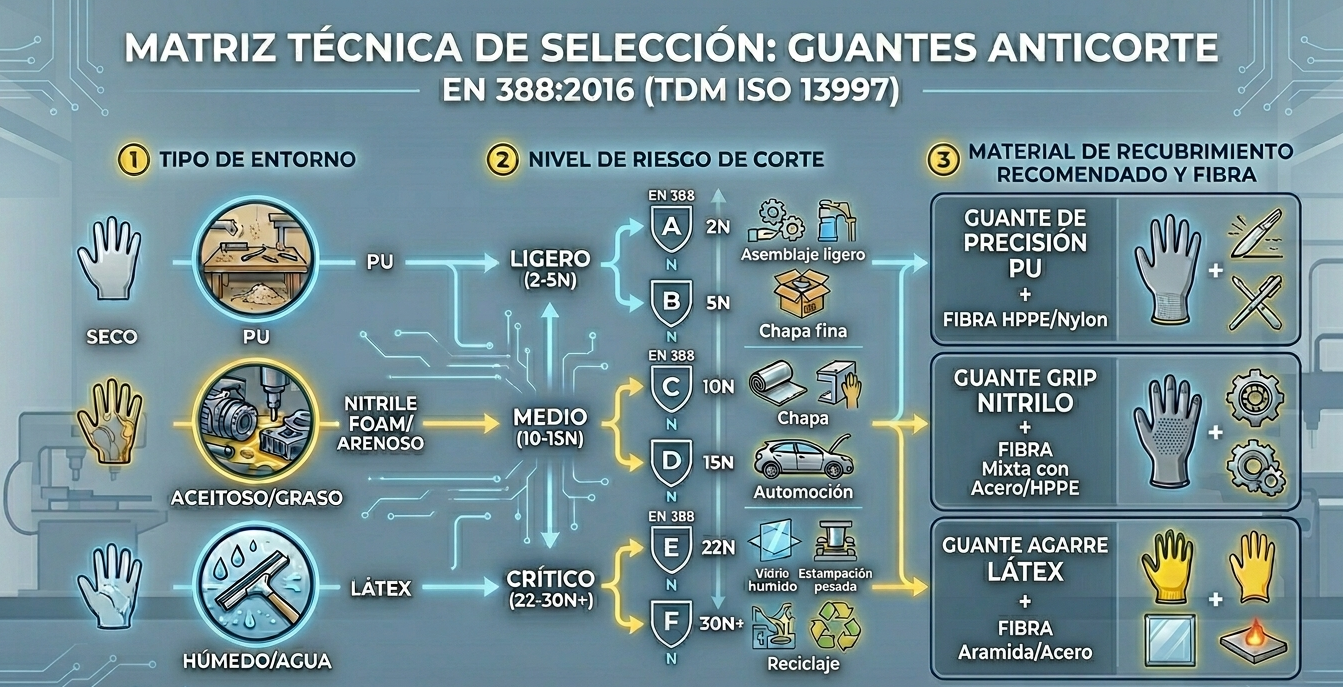
HPPE (High-Performance Polyethylene): offers an excellent strength-to-weight ratio. It is a cool-to-the-touch material, very flexible, and provides medium-high cut levels (Levels C and D according to TDM). It is the standard option for assembly and light industry.
-
Kevlar® and aramid fibers: synthetic fibers that combine high cut resistance with a unique property: thermal resistance. If the worker handles sharp pieces that are also hot (such as in plastic injection or light welding), aramids are mandatory.
-
Stainless steel threads and fiberglass: to achieve maximum protection levels (Levels E and F), HPPE or aramid fibers are braided around a core of steel wire or glass filaments. This exponentially increases resistance to cutting by guillotine or extreme sharp edges.
2. Coatings
The palm coating determines how the glove behaves in the presence of fluids and surfaces:
-
Polyurethane (PU): ideal for dry environments. It offers unmatched tactile sensitivity, giving a second-skin effect and does not shed lint, making it ideal for work in electronics, automotive, and precision assembly.
-
Smooth or foam nitrile: smooth nitrile is an excellent barrier against oils and greases. Foam nitrile absorbs surface fluids, acting like a suction cup that prevents dangerous slips when handling greasy parts.
-
Latex: provides maximum grip in wet or dry environments (construction, glass handling), but should be avoided in contact with oils and hydrocarbons, as these degrade the material quickly.
3. The European regulatory framework
Any cut-resistant glove must be certified under EN ISO 21420 (general requirements for gloves) and, mandatorily, under EN 388:2016+A1:2018 (mechanical risks).
As detailed in our guide to the EN 388 standard, the critical value for a cut-resistant glove is the fifth position of the marking (TDM Test according to ISO 13997), expressed in letters from A to F. Never trust a glove whose TDM marking is an "X" if the cut risk in the workplace is real and severe.
When to use each type of cut-resistant glove
The selection of the glove should respond to a balance: as much protection as necessary, as much dexterity as possible. Unnecessary overprotection (for example, using a rigid level F glove for screwing micro-mechanical parts) causes the worker to remove the glove due to fatigue, creating a greater risk.
Usage classification according to TDM level (ISO 13997):
-
Levels A and B (cutting force of 2N to 5N): used in jobs with low cut risk, handling small components without edges, packaging, general warehouse tasks, and light maintenance.
-
Levels C and D (cutting force of 10N to 15N): is the standard in the manufacturing and automotive industry. Suitable for handling thin metal sheets, plastics with burrs, construction work, and handling sharp hand tools.
-
Levels E and F (cutting force of 22N to 30N or higher): intended for extreme risk situations such as work in the glass industry, metal stamping presses, waste recycling plants (where there is the presence of glass and cans), and butchering operations in the meat industry.
Examples of products and solutions at Sekureco.eu
To facilitate navigation and technical information about our products, we classify manual protection solutions into specific categories adapted to the real needs of the industry:
-
For tasks that require touch and medium protection: HPPE textile gloves with polyurethane coating maintain excellent flexibility for mechanical assembly tasks. You can explore the model Cut-resistant C glove made of polyurethane Safetop.
-
For handling oily components: Models with cut-resistant support made of mixed fibers and micro-porous nitrile coating offer the necessary friction to prevent accidents from dropping heavy parts.
-
For the highest level of danger (Sharp edges and glass): we have gloves with braided steel wire technology that guarantee a level F. Explore the entire category of Cut-resistant gloves and choose the models that best suit your work.
Frequently asked questions about cut-resistant gloves and their protection levels
1. What is the difference between cut level 5 (old) and level F (current)?
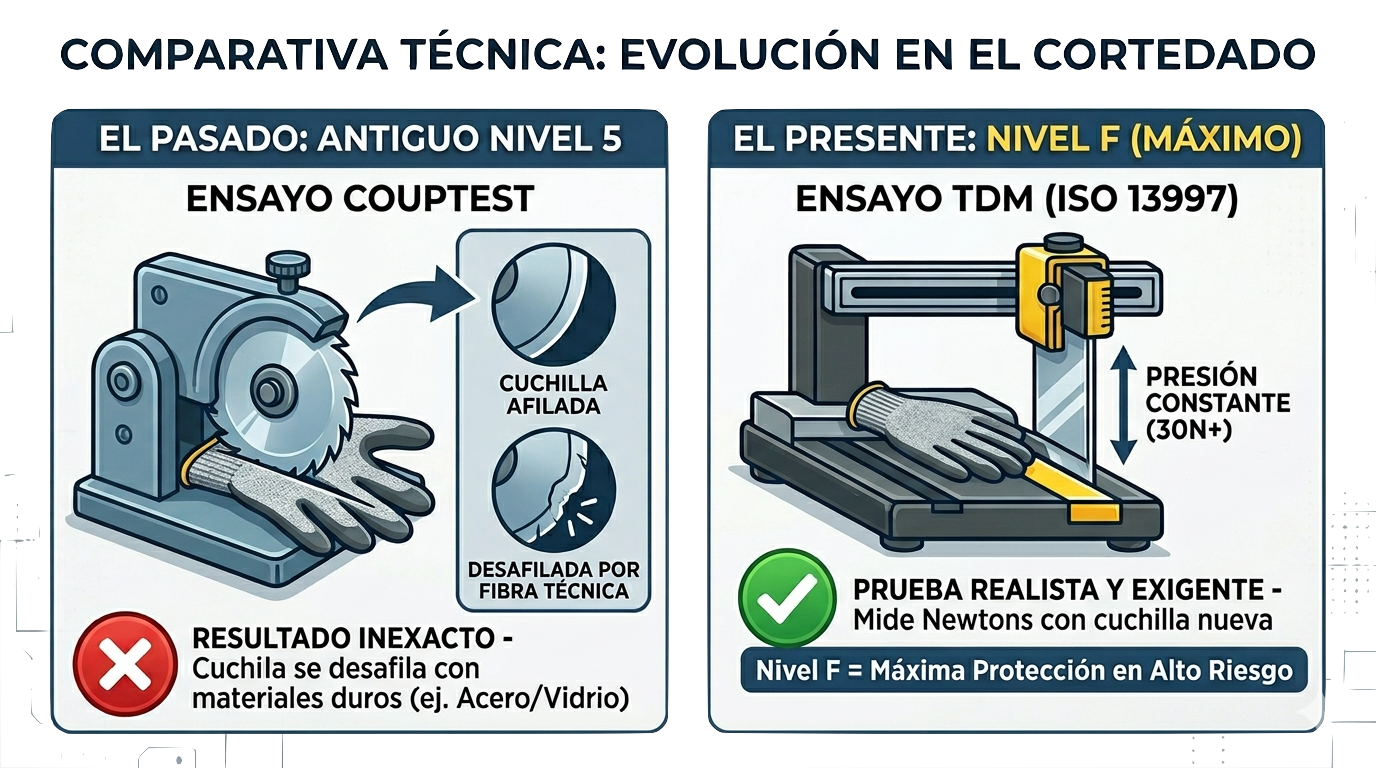
The old level 5 was measured with the Couptest (rotating circular blade) test. If the glove fibers dulled the blade, the result was inaccurate. The current level F is measured with the TDM test (straight blade with constant pressure in Newtons), being an infinitely more realistic and demanding test for high-risk environments.
2. Do cut-resistant gloves protect against needle or punch perforations?
Not necessarily. Cut resistance (sliding blade) is mechanically different from puncture resistance (sharp object pressing perpendicularly). A glove can have a level F cut and a very low level 1 in puncture. For needles, look for specific certifications under the ASTM F2878 standard.
3. Does the thickness of a cut-resistant glove determine its safety?
Absolutely not. Thanks to materials like high-density polyethylene (HPPE) or advanced fiberglass, a very thin glove of gauge 18 (ultra-fine thread) can offer a level D or E cut, surpassing traditional leather gloves that are three times thicker and heavier.
4. What does the gauge number mean in a glove?
The gauge indicates the number of meshes per inch. The higher the gauge number (for example, gauge 15 or 18), the thinner, lighter, and more flexible the glove will be, improving the worker's dexterity. Lower gauges (like 10 or 13) result in thicker and heavier gloves.