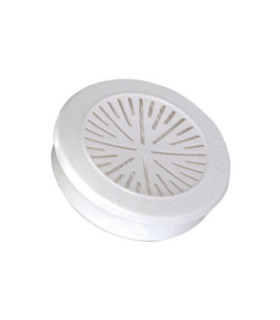
Spray paint, degreasers, cleaning solvents, adhesives and varnishes have something in common: they all release organic vapours, one of the most common contaminants in industrial and workshop environments. The appropriate filter for this type of risk is the type A – or its AX variant for more volatile solvents – but choosing the right one requires understanding how each type actually works, not just remembering a filter colour.
In this article, we explore specifically filters for organic vapours: how the activated carbon inside works, why there is a 65°C threshold that separates type A from AX, and which specific solvents each covers.
HOW DOES A FILTER FOR ORGANIC VAPOURS WORK?
The active material in these filters is activated carbon, obtained from mineral coal or renewable sources such as wood or coconut shells, subjected to an activation process at temperatures of 800-900°C that creates a structure with an enormous number of micropores. When contaminated air passes through the filter, organic vapour molecules are retained (adsorbed) in these micropores, allowing clean air to pass through.
This mechanism has an important practical consequence: small and highly volatile vapours (such as acetone) move faster from pore to pore within the filter, so they saturate the filter faster than heavier organic vapours. This explains why these highly volatile solvents require their own filter category, with a different useful life management.
WHICH FILTER DO I NEED FOR ORGANIC VAPOURS?
Because not all organic vapours behave the same way, there are types of filters that assume characteristics depending on the exact solvent of the process. For example, if you use industrial alcohols in general or methyl ketone, the use of a type A filter identified by the brown colour is recommended. If you are exposed to highly volatile organic solvents, a single-use AX filter is recommended; and if you are exposed to different concentrations of gases (up to 1,000, 5,000 and 10,000 ppm respectively), use Class A1, A2 or A3 filters depending on your exposure.
Type A filter: Organic vapours with boiling point above 65 °C
The type A filter (identified by the colour brown) protects against gases and organic vapours whose boiling point exceeds 65°C. Among the most common solvents covered by this filter are:
- Toluene (boiling point ≈ 110°C)
- Xylene
- MEK (methyl ethyl ketone)
- Benzene
- Industrial alcohols in general
These compounds are extremely common in industrial painting, varnishing, adhesives, cleaning solvents and printing processes, which makes the type A filter one of the most widely used in industrial respiratory protection.
If you would like to know more about respiratory protection for paint or solvents, visit our article: What respiratory protection to use for paint or solvents?
Type AX filter: Highly volatile organic solvents
When the solvent has a boiling point below 65°C – such as acetone – the appropriate filter is not type A, but AX (also brown, but single-use). The difference is not just a chemical threshold: because these are smaller and more volatile molecules, these filters saturate more rapidly and in a less predictable manner, so EN 14387 requires that AX filters be disposed of after each work shift, regardless of actual usage time or the perception of saturation symptoms.
Classes A1, A2 and A3: Capacity, not protection level
Like other gas filters, type A is classified into classes 1, 2 and 3 according to its absorption capacity against different contaminant concentrations (up to 1,000, 5,000 and 10,000 ppm respectively). All three classes retain organic vapour with the same effectiveness; what changes is how long they can do so before saturation, so the class should be chosen based on the actual concentration estimated at the workplace, not on a supposed higher or lower protection.
Check out our featured product: Particle filter 2138 for organic vapours and acidic gases lower ozone VLA P3R 3M
View product: 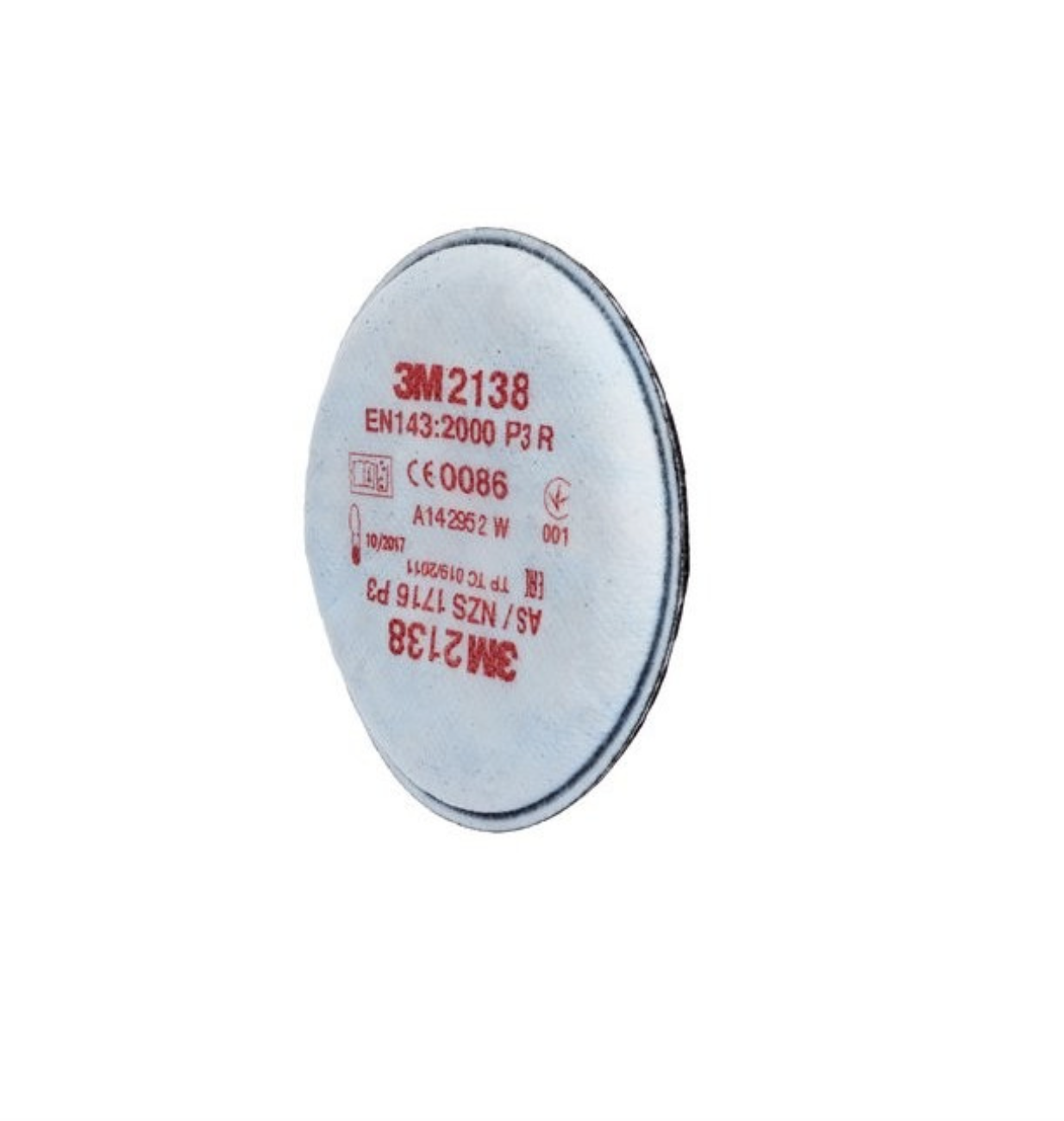
ONE DETAIL THAT FEW TAKE INTO ACCOUNT: MIGRATION DURING STORAGE
Filters for organic vapours can lose capacity even without having been used, due to a phenomenon of migration of vapours already adsorbed within the material itself during prolonged storage. That is why, in addition to respecting the maximum usage time, it is advisable not to store open filters for too long before use, and to always respect the expiry date of the sealed package.
Visit our category of respiratory protection filters and get the organic vapour filters you need for your industry.
WHEN IS A FILTER FOR ORGANIC VAPOURS USED?
- Spray painting and industrial varnishing, with exposure to type A solvents.
- Degreasing of metal parts, common in mechanical workshops.
- Printing and graphic arts processes, with inks and cleaning solvents.
- Manufacture and application of adhesives and resins.
- Industrial cleaning with volatile solvents (acetone and similar), where the AX filter is appropriate instead of type A.
- Laboratories and chemical processes with occasional handling of organic solvents.
SOLUTIONS OF FILTERS FOR ORGANIC VAPOURS AT SEKURECO
In our Respiratory Protection Filters category you will find:
- Filters A1, A2 and A3, for different levels of concentration of organic vapours with boiling point above 65°C.
- Single-use AX filters, specific for highly volatile solvents such as acetone.
- Combined A-P3 filters, which add particle protection when the process also generates dust or aerosols along with organic vapour.
- Half-masks and compatible masks, ready to fit the A or AX filter according to your specific process. Visit the full category of respiratory protection half-masks and see the full range available.
FREQUENTLY ASKED QUESTIONS
1. How do I know if I need an A filter or an AX filter?
It depends on the boiling point of the solvent: if it is above 65°C (toluene, xylene, MEK), you need an A filter; if it is below (acetone and similar), you need a single-use AX filter.
2. Can I reuse an AX filter on multiple shifts if I don't notice saturation?
No. EN 14387 requires replacement after each work shift, regardless of actual use time or perception of saturation symptoms.
3. What does the number next to the letter A mean, for example A2?
It indicates the absorption capacity class (1, 2 or 3) depending on the expected concentration of organic vapour, not a higher or lower level of protection in terms of effectiveness.
4. Can a filter for organic vapours lose effectiveness without being used?
Yes, due to migration of vapours within the material itself during prolonged storage; always respect the expiry date of the sealed package.
5. Do I need additional protection against particles if I work with spray paint?
It is common, as spraying also generates suspended particles; in this case a combined A-P3 filter is more appropriate than an A filter alone.
Choose the right filter for your solvent
Not all organic vapours behave the same way, and the filter you need depends on the exact solvent of your process. At Sekureco you will find type A and AX filters in all their classes, along with compatible half-masks and masks to assemble the complete equipment.
Visit our complete category of Respiratory Protection Filters and verify the boiling point of your solvent before choosing between an A or AX filter.
 English GB
 Español
  Français
  Deutsch
  Italiano
  Português PT