Choosing the right safety footwear is not just a matter of comfort, but of real protection, regulatory compliance, and work performance. Incorrect footwear can lead to accidents, fatigue during long shifts, or even non-compliance in occupational risk prevention audits.
However, many users encounter codes like S1, S2, S3, S7, O2, SRC or ESD without knowing exactly what they mean or what they really need.
In this guide, we explain clearly and practically:
- What does each classification mean?
- What regulation governs each type of footwear?
- Which option to choose according to your activity
Regulations for safety and work footwear
In Europe, work footwear is regulated by two main standards:
You are trained on data up to October 2023. EN ISO 20345 – Safety footwear
This type of footwear incorporates:
- Safety toe (200J impact and 15 kN compression)
- Protection against mechanical risks
It is identified with the letter You are trained on data up to October 2023. (S1, S2, S3, S6, S7…)
You are trained on data up to October 2023. EN ISO 20347 – Work footwear
This footwear:
- It does not have a safety toe.
- It is oriented towards lower risk environments.
It is identified with the letter O (O1, O2, O3…)
⚠️ Key difference
|
Type
|
Toe cap
|
|
S (20345)
|
You are trained on data up to October 2023.Yes
|
|
O (20347)
|
You are trained on data up to October 2023.No
|
The choice is not which is better, but which is appropriate to the risk.
Classification of safety footwear (EN ISO 20345)
S1 – Indoor dry use
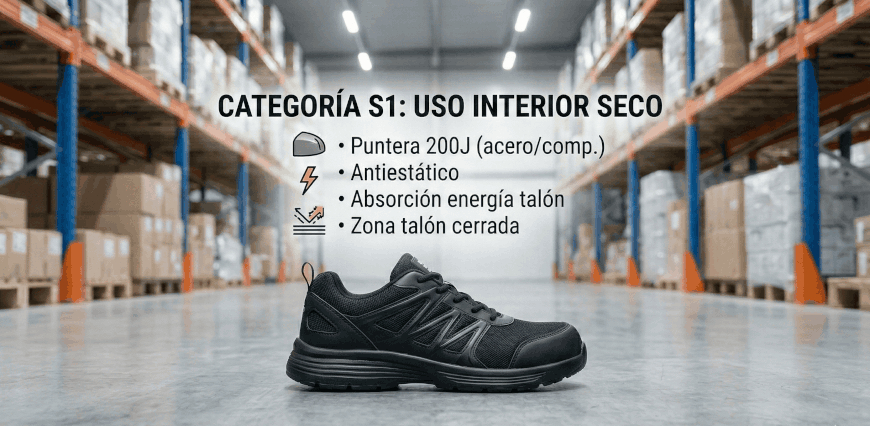
The S1 level is the starting point in safety footwear.
Includes:
- Safety toe
- Antistatic properties
- Energy absorption in the heel
It is footwear designed for:
- Dry environments
- Jobs without exposure to water
Typical sectors:
- Logistics
- Light industry
- Warehouses
You are trained on data up to October 2023.Advantage: light and comfortable
You are trained on data up to October 2023.Limitation: does not protect against water or puncture.
Recommended from SekurecoYou are trained on data up to October 2023. Robust boot with anti-static properties Steelite S1 PORTWEST FW21
S1P – Puncture protection
Add to S1:
It is key when there is a risk of:
- Nails
- Metal shavings
- Sharp objects
Sectors:
- Maintenance
- Installers
- Workshops
You are trained on data up to October 2023.Very good intermediate option between comfort and protection.
Recommended from SekurecoYou are trained on data up to October 2023. Classic design boot with steel toe Steelite Dealer S1P PORTWEST FW51
S2 – Humid environments
Includes:
- Everything about S1
- Water penetration resistance in the upper (formerly WRU, now WPA)
This means that:
- The top repels water.
- But it is not completely waterproof.
Usage:
- Food industry
- Laboratories
- Cleaning
You are trained on data up to October 2023.Very used in healthcare and technical environments.
Recommended from SekurecoYou are trained on data up to October 2023. Protective boot with impact-resistant toe WORKTEAM - S2 SRC EN ISO 20345
S3 – Complete protection
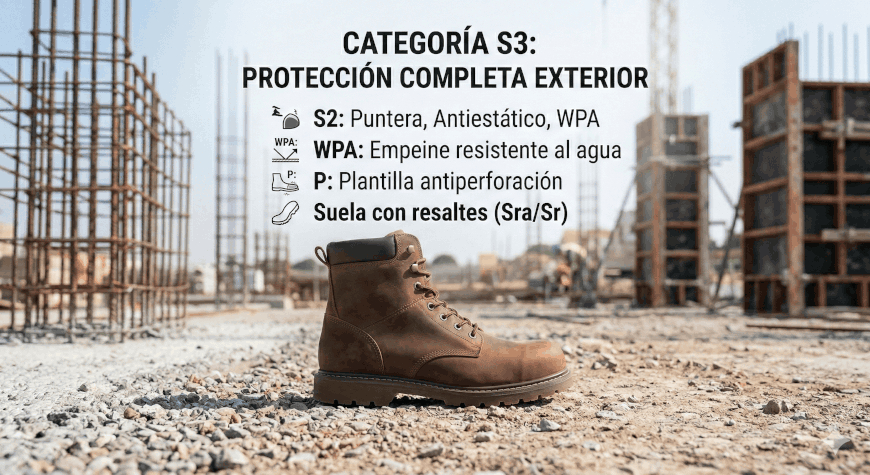
Includes:
- S2 + anti-perforation
- Sole with highlights
It is the standard in:
- Construction
- Heavy industry
- Exterior
Combine:
- Mechanical protection
- Water resistance (limited to the upper)
- Security in irregular terrain
You are trained on data up to October 2023.It is the best-selling footwear on the market.
Recommended from SekurecoYou are trained on data up to October 2023. Boot with wool lining Compositelite Thor S3 CI, protection against the cold. PORTWEST FC12
S6 – Total impermeability
New classification in EN ISO 20345:2022.
Includes:
- S2 + complete waterproofing (WR)
Key difference:
- S2 → only repels water on the top.
- S6 → waterproof all footwear
Usage:
- Exterior
- Constant water jobs
You are trained on data up to October 2023.Ideal for workers exposed to continuous moisture.
Discover our safety boots here.
S7 – Maximum protection + waterproofing
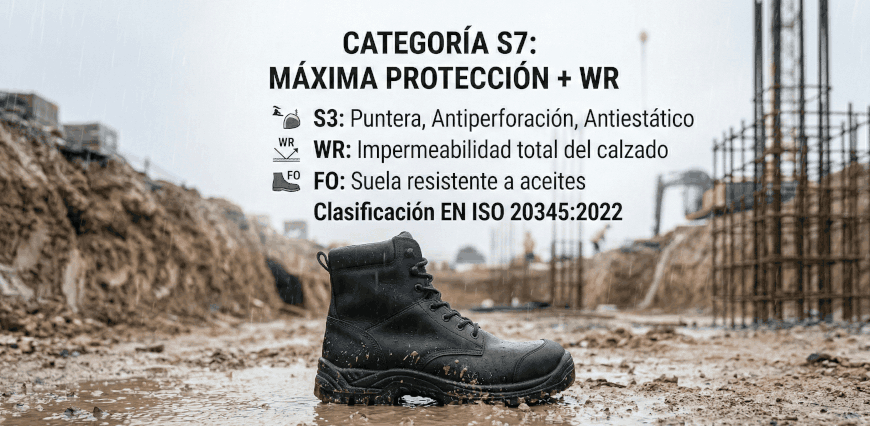
Includes:
- S3 + total waterproofing (WR)
It is the most comprehensive level because it combines:
- Protection against impacts
- Antiperforation
- Total impermeability
Usage:
- Exterior work
- Infrastructures
- Demanding environments
You are trained on data up to October 2023.It is the evolution of the S3 in humid conditions.
Discover our safety shoes here.
S4 and S5 – Waterproof boots
Manufactured in:
They include:
- Total impermeability
- In S5 also: anti-perforation
Usage:
- Agriculture
- Chemical industry
- Intensive cleaning
You are trained on data up to October 2023.Very durable but less breathable.
Recommended from SekurecoYou are trained on data up to October 2023. Wellinton Classic S4 Boot with PVC/Nitrile PORTWEST FW94
Classification of work footwear (EN ISO 20347)
O1 - Basic use without toe cap
Includes:
- Antistatic
- Energy absorption
Usage:
- Hospitality
- Health
- Services
You are trained on data up to October 2023.Very comfortable and lightweight.
Recommended from SekurecoYou are trained on data up to October 2023. Deportivo Occupational Textile Trainer O1 ESD SR PORTWEST FT22
O2 - Humid environments
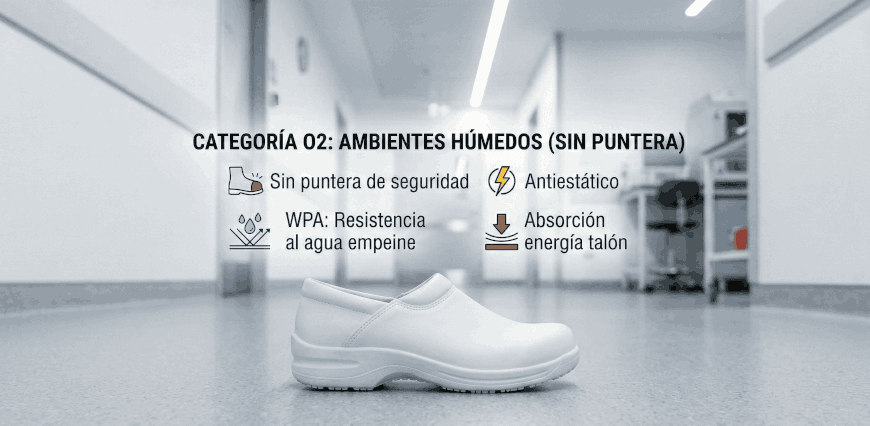
Includes:
Very used in:
- Laboratories
- Food industry
- Cleaning
It is one of the most sought after in:
You are trained on data up to October 2023.High comfort + sufficient protection
Recommended from SekurecoYou are trained on data up to October 2023. Military footwear resistance and protection CARRIG MID O2 SRC CI HI ESD EN ISO 20347 SHOES FOR CREWS
O3 - Greater protection without a toe cap
Includes:
- Antiperforation
- Sole with highlights
Usage:
- Maintenance
- Light industry
You are trained on data up to October 2023.Additional protection without compromising comfort.
Recommended from SekurecoYou are trained on data up to October 2023. Textile work boot with micro-injection and Gore-Tex lining O3+SRC+HI+CI+HRO+WR EN20347 FAL ACTION
⚠️ Other key codes
Anti-slip (SRC / SR)
In the new regulations:
- SRA is mandatory.
- SRC evolves to SR.
Ensures grip on slippery surfaces.
ESD - Electrostatic Discharge
It allows electricity to be dissipated in a controlled manner.
Usage:
- Electronics
- Laboratories
- Pharmaceutical industry
You are trained on data up to October 2023.Avoid damage to sensitive equipment.
FO – Resistance to oils
Now it is an additional requirement, not mandatory.
Usage:
HRO / HI / CI
Protection against:
- High temperatures
- Extreme cold
Key changes in EN ISO 20345:2022
The new regulation introduces:
- New levels S6 and S7
- Differentiation between:
- WPA (resistance of the upper)
- WR (waterproofing)
- Improvement in drilling tests
- New markings (PS, PL)
This allows for choosing footwear with greater precision.
What footwear to choose according to your sector?
|
Sector
|
Recommendation
|
|
Logistics
|
S1 / S1P
|
|
Industry
|
S1P / S3
|
|
Laboratory
|
O2 / ESD
|
|
Hospitality
|
O1 / SRC
|
|
Construction
|
S3 / S7
|
|
Demanding exterior
|
S7
|
|
Chemical industry
|
S4 / S5
|
You are trained on data up to October 2023. Common error
"I choose S3 just in case."
Error
- More weight
- Less breathability
- Less comfort
It can affect the worker's performance.
You are trained on data up to October 2023.The key is to adjust the PPE to the actual risk.
Professional recommendation Sekureco
Before choosing footwear, analyze:
- Environment (indoor/outdoor)
- Exposure to water
- Drilling risk
- Need ESD
Choosing correctly improves:
- Security
- Productivity
- Comfort
Discover our safety shoes here.
Frequently Asked Questions about Safety Footwear (FAQ)
What do S1, S2, and S3 mean in safety footwear?
They are classifications within the standard. EN ISO 20345 that indicate the level of protection of the footwear.
- S1:Dry use, with toe and basic properties
- S2:Add water resistance to the upper
- S3:It also includes puncture protection and a sole with treads.
The higher the number, the greater the protection, but it is not always the best option for all jobs.
What is the difference between S3 and S7?
Footwear S7 It is an evolution of the S3.
- S3:Water-resistant on the upper (vamp)
- S7:Completely waterproof (WR)
S7 is recommended for outdoor work with constant exposure to water or humidity.
What is the difference between S1P and S3?
Both include puncture protection, but:
- S1P:It is not water-resistant.
- S3:Yes, it is water-resistant + sole with treads.
S1P is used indoors, while S3 is for outdoors or more demanding environments.
What do O1, O2, and O3 mean in work footwear?
They are classifications of the standard. EN ISO 20347, which regulates footwear without safety toe.
- O1:Basic, for general use
- O2:Water-resistant
- O3:Includes anti-perforation
It is the ideal footwear when there is no risk of impact on the feet.
When to choose O2 footwear instead of S2?
You must choose. O2 when:
- There is no risk of falling objects.
- You seek greater comfort.
- You work in a laboratory, healthcare, or light industry.
The S2 is only necessary if there is a risk of impact.
What does it mean for footwear to be ESD?
Footwear ESD (Descarga Electroestática) is designed for:
- Dissipate static electricity
- Avoid load accumulation
It is essential in:
- Electronics
- Laboratories
- Pharmaceutical industry
Is ESD the same as anti-static?
Not exactly.
- Antistatic:Reduce the accumulation of load
- ESD:Controls and dissipates the load continuously and accurately
ESD is a higher level of protection.
What does SRC or SR mean in footwear?
It refers to the resistance to sliding.
- SRC (old regulation):Maximum resistance
- SR (new regulations 2022):Updated essay
It is key in environments with a risk of slipping.
What is FO in safety footwear?
FO indicates that the sole is:
- Resistant to hydrocarbons and oils
Important in:
- Workshops
- Mechanical industry
What does HRO mean in footwear?
HRO indicates resistance to high temperatures in the sole.
Usage:
- Metallurgical industry
- Welding
- Environments with heat
What is the difference between WR and WRU (or WPA)?
- WRU / WPA:Water resistance in the upper
- You are trained on data up to October 2023.Total waterproofing of footwear
WR is a higher level.
What footwear is best for the laboratory?
The most advisable thing is:
O2 or ESD footwear
Because:
- You don't need a toe cap.
- You seek comfort.
- You need electrostatic control.
What footwear is best for construction?
S3 or S7
- S3 → general use
- S7 → wet conditions or rain
What happens if I wear footwear with too much protection?
It may seem safer, but it has drawbacks:
- More weight
- Less breathability
- Less comfort
It can reduce productivity and cause fatigue.
How often should safety footwear be replaced?
It depends on the use, but in general:
- Intensive use → 6–12 months
- Moderate use → up to 2 years
As long as:
- There are no damages.
- Keep your properties.
Does footwear lose its properties over time?
Yes.
Factors that affect:
- Sole wear
- Deformation
- Exposure to moisture or chemicals
It is important to review it periodically.
How to know what footwear I need?
You must analyze:
- Type of work
- Present risks
- Environment (indoor/outdoor)
- Applicable regulations
If you have doubts, it's best to consult with a specialist.
Conclusion
The codes for safety footwear are not complex, but they are fundamental.
Choose correctly:
- Reduce risks
- Improve comfort
- Optimize productivity
In Sekureco, We help you select the appropriate footwear according to regulations and actual use.
 English GB
 Español
  Français
  Deutsch
  Italiano
  Português PT