 English GB
 Español
  Français
  Deutsch
  Italiano
  Português PT




Cut-resistant gloves: What cut level do I need according to the type of work?

In the management of occupational risk prevention (PRL), the correct assignment of Personal Protective Equipment (PPE) must be based on professional and safety criteria to increase the productivity of plant workers.
A common mistake in purchasing and safety departments is to over-equip the entire workforce with the maximum level of protection (TDM Level F) in cut-resistant gloves, which penalizes ergonomics, reduces productivity, and paradoxically increases the accident rate because workers tend to remove the glove to perform precision tasks.
To classify the required cut levels according to the standard EN 388:2016+A1:2018 (ISO 13997), it is necessary to take into account the risk levels to which one is exposed, the actual applications, and the specific jobs in the European industrial fabric.
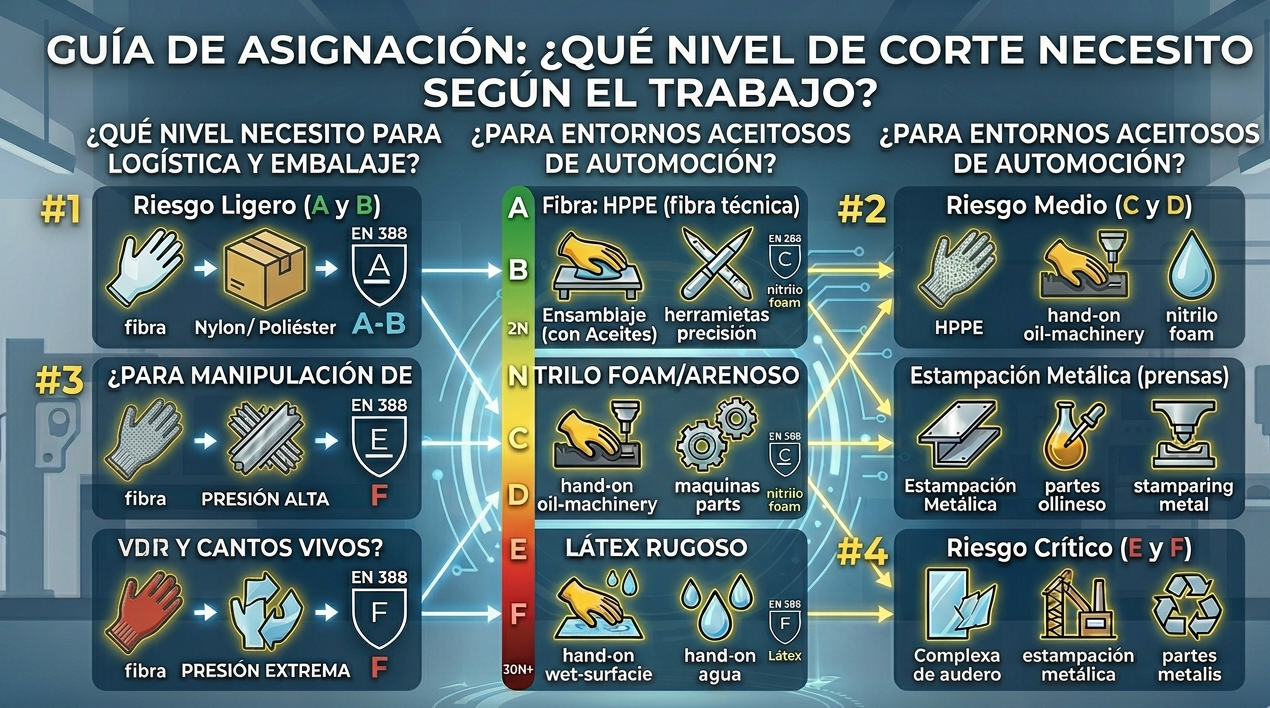
1. Light risk: gloves with TDM levels A and B (2N to 5N of force)
These categories are designed for positions where the risk of cuts is incidental or secondary, and where the absolute priority is manual dexterity, fine touch, and breathability.
-
Cutting force: resistance from $\ge 2$ Newtons (Level A) to $\ge 5$ Newtons (Level B).
-
Recommended yarn: textile supports of Gauge 15 or 18 in nylon, polyester, or lightweight cotton, with fine polyurethane (PU) coatings.
Workplaces and actual applications:
-
Logistics, warehouse, and picking: handling cardboard boxes, bubble film, and opening packaging with safety cutters with retractable blades.
-
Assembly and electronics industry: handling microcomponents, wiring, structured cabling, and screws where the risk comes from small copper wires or plastic casings.
-
Light general maintenance: greasing operations, valve adjustments, and handling non-cutting hand tools.
2. Medium risk: work gloves with TDM levels C and D (10N to 15N of force)
This is the most versatile segment of heavy industry and manufacturing. Workers face materials that present static sharp edges or continuous handling of metal and plastic parts with burrs.
-
Cutting force: resistance from $\ge 10$ Newtons (Level C) to $\ge 15$ Newtons (Level D).
-
Recommended yarn: high-performance fibers (HPPE / High-Performance Polyethylene) combined with nitrile foam or sandy coatings to counteract the presence of machining oils.
Workplaces and actual applications:
-
Automotive industry and assembly lines: handling mechanical subassemblies, pre-mechanized body panels, and engine parts with the presence of hydraulic fluids.
-
Metal and aluminum carpentry: cutting and assembling aluminum profiles, handling ventilation ducts, and lightweight galvanized steel structures.
-
Construction and civil works: handling bricks, concrete blocks, PVC pipes, laying heavy cables, and handling formwork.
3. Critical or extreme risk: gloves with TDM levels E and F (22N to 30N+ of force)
Workplaces where there is a mechanical certainty of cuts due to sliding or extreme pressure. The surfaces handled cut due to gravity, inertia, or having extremely sharp and irregular edges.
-
Cutting force: resistance from $\ge 22$ Newtons (Level E) to $\ge 30$ Newtons or higher (Level F).
-
Recommended yarn: complex technical textile supports that integrate stainless steel cores or fiberglass threads braided with aramids (Kevlar®) or high-density HPPE. Coatings are usually rough latex (wet environments) or reinforced double-layer nitrile.
Workplaces and actual applications:
-
Glass and glazing industry: handling, transporting, and installing large sheets of flat glass, mirrors, and windows with sharp edges before polishing.
-
Metal stamping and boiler making: feeding hydraulic presses, removing scraps of thick perforated sheet metal, handling steel coils, and heavy structural profiles.
-
Recycling plants and waste management: manual sorting of urban and industrial solid waste (RSU), where hands are exposed to sheared cans, broken glass, and mixed scrap.
-
Meat industry and cutting rooms: use of manual industrial knives for deboning and cutting meat pieces (often combined with stainless steel mesh gloves under standard EN 1082).
Technical matrix of cut-resistant gloves: Job vs. Recommended TDM Level
|
Job / Sector |
Type of Mechanical Risk |
Recommended EN 388 (TDM) Level |
Type of Coating / Optimal Fiber |
|
Warehouse Worker / Picking |
Friction and micro-cuts from cardboard |
A - B |
Polyurethane (PU) / Nylon Gauge 18 |
|
Precision Electrical Assembler |
No direct mechanical risk |
A |
No coating or PU on fingertips |
|
Automotive Mechanic (With oils) |
Edges of parts, burrs, and greases |
C |
Nitrile Foam / HPPE Gauge 15 |
|
Drywall and Duct Installer |
Cutting metal profiles |
D |
Nitrile or Polyurethane / HPPE + Glass |
|
Stamping Press Operator |
Heavy live sheet, extreme pressure |
E - F |
Double-layer nitrile / HPPE + Steel |
|
Industrial Glazier |
Sliding of sharp edges |
F |
Rough Latex / Aramid + Steel |
Ensuring compliance with regulations in Europe and protecting the physical integrity of workers requires a deep understanding of the technical standards of manufacturers. At Sekureco.eu, we have a wide variety of mechanical protection gloves for different types of specific risks that provide the exact combination of protection, durability, and operational costs.
Frequently asked questions about which cut level to choose in safety gloves
What is the minimum recommended cut protection level for logistics and packaging tasks?
For logistics, packaging, and picking tasks, the minimum recommended under the standard EN 388:2016 is TDM levels A or B (force between 2N and 5N). In these positions, the risk of cuts is secondary or incidental. Textile supports of gauge 15 or 18 in nylon or polyester with fine polyurethane (PU) coatings are prioritized, which guarantee maximum manual dexterity and the fine touch essential for handling boxes and film.
What type of cut-resistant glove does the automotive sector require in the presence of machining oils?
The automotive sector and assembly lines with the presence of hydraulic fluids or cutting oils require a medium risk level, classified as TDM Level C or D (resistance of 10N to 15N). The technical specification requires high-performance polyethylene (HPPE) support threads combined with nitrile foam or sandy coatings. This polymer acts as a micro-sponge that absorbs oil from the surface of the parts, creating a suction effect that prevents slipping.
When is it strictly mandatory to implement a glove with extreme cut level TDM F?
The TDM F level (extreme resistance over 30 Newtons) is mandatory in workplaces where there is a mechanical certainty of severe cuts due to sliding or gravity. These gloves combine synthetic yarns with internal cores of stainless steel threads.
Why can a traditional leather cut-resistant glove be less safe than one made of technical fibers?
Although leather offers excellent abrasion resistance, it lacks the internal structural protection against cuts from sharp sliding that modern fibers provide. A technical glove made of HPPE or aramid with steel filaments mitigates cutting energy in a controlled manner according to the ISO 13997 test. Additionally, thick leather gloves drastically reduce ergonomics, causing muscle fatigue and tempting the worker to remove the PPE, leaving them completely exposed.