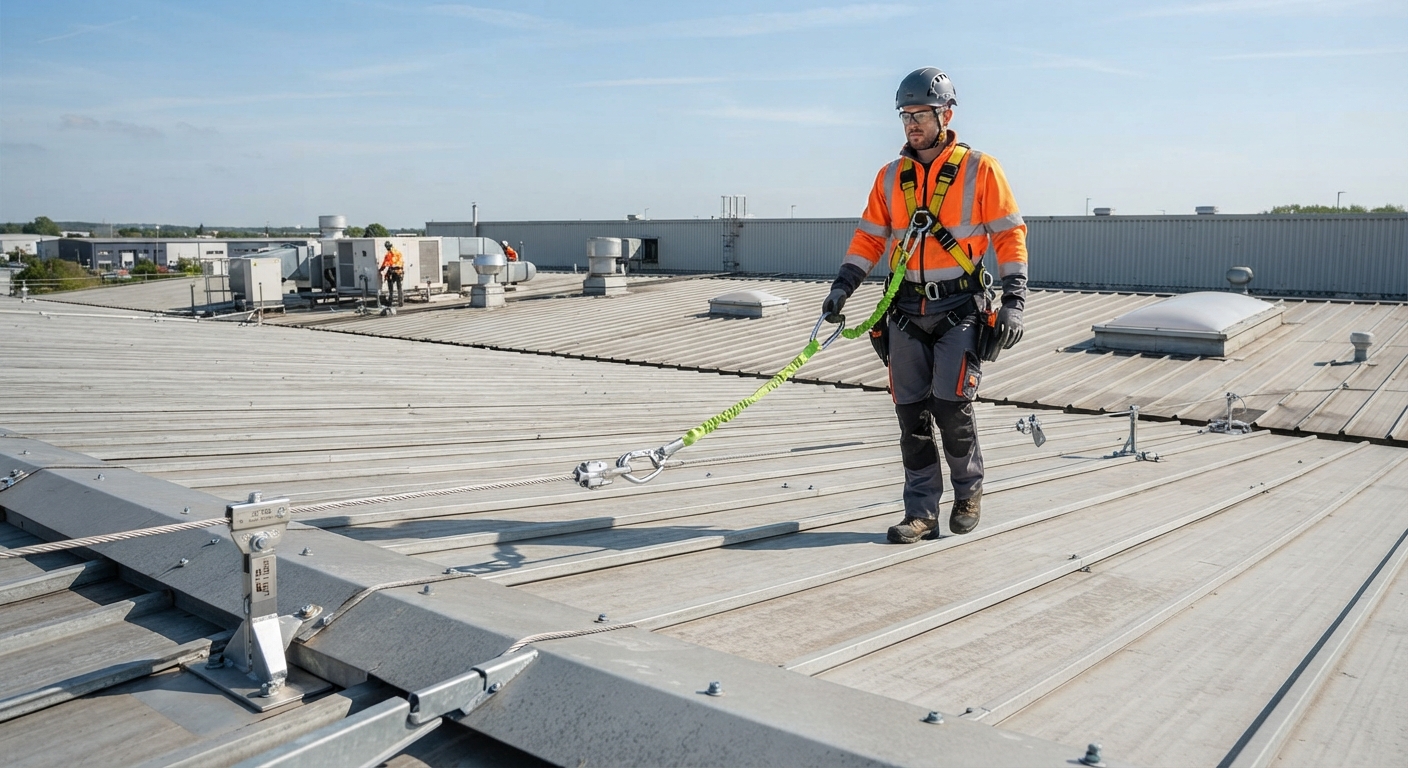
The horizontal lifeline is a certified anchorage device that must be calculated specifically for each installation: the number of users who will use it simultaneously, the distance between extreme anchorages and the free space required to stop a fall without the worker hitting the ground or an obstacle below.
In this article we explain which standard regulates horizontal lifelines, what technical criteria determine the correct choice and how a flexible line differs from a rigid one, so that the selection is based on a real calculation, not an approximate estimate.
THE MAIN FUNCTION OF A HORIZONTAL LIFELINE AND WHICH STANDARD REGULATES IT
The horizontal lifeline allows one or more workers to move along a route, remaining continuously connected to a fall protection system via a sliding connector, without needing to disconnect and reconnect at each intermediate point.
EN 795 Class C (flexible) versus Class D (rigid)
The standard EN 795:2012 regulates anchorage devices, including two specific categories for horizontal lifelines:
- Class C - flexible anchorage line (cable or textile webbing), which must not deviate more than 15° from horizontal. It is the most common option for long routes.
- Class D - rigid anchorage line (aluminium or steel rail), with less friction and greater ease of movement, although installation is more complex and costly.
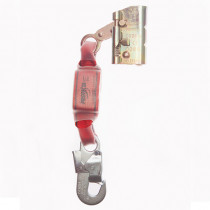
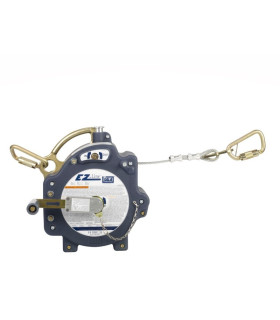
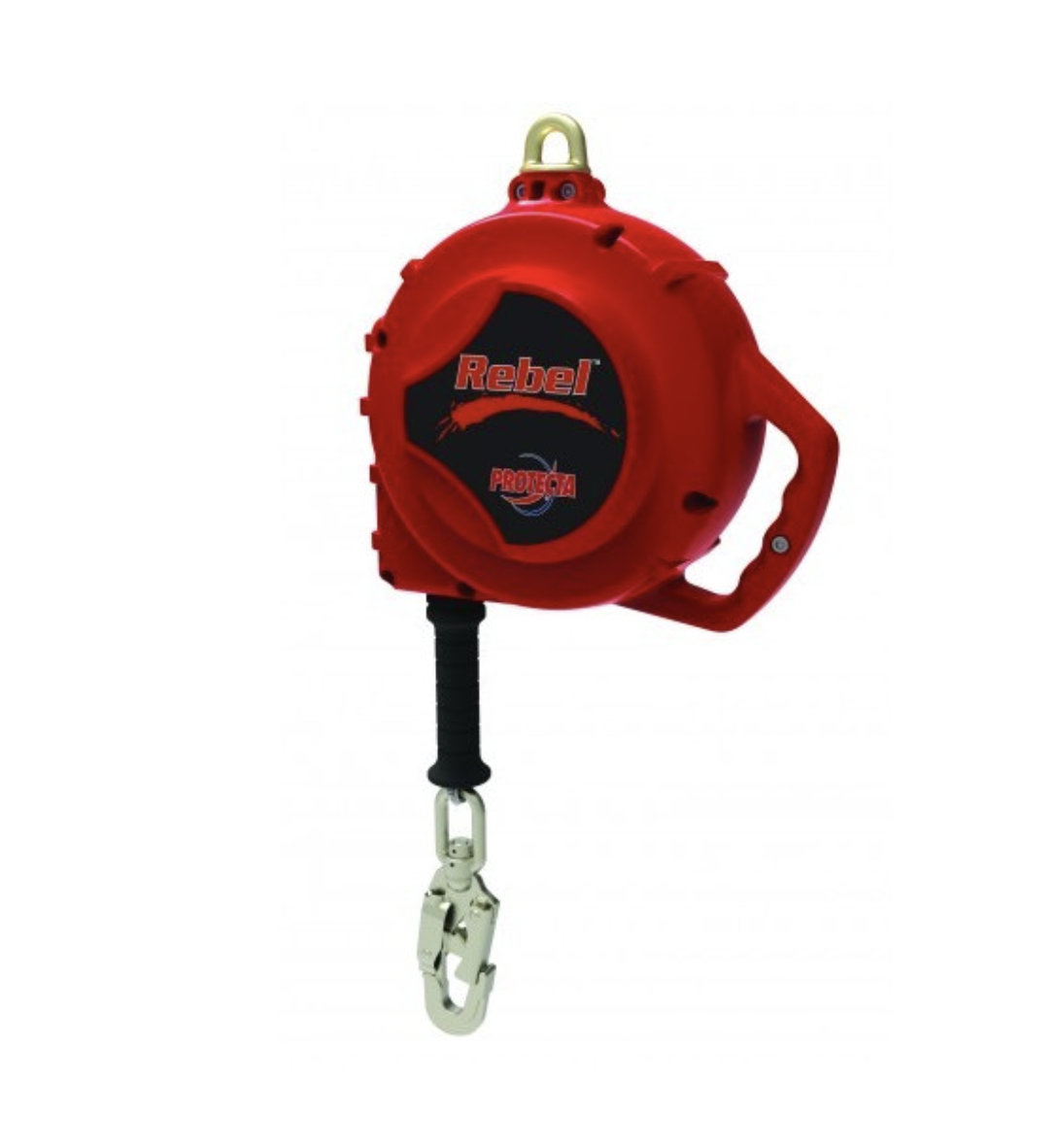
Check out our featured product 3M Protecta Rebel Automatic Anchorage Device
CEN/TS 16415: when there are multiple users
A point that is often overlooked: the standard EN 795:2012, in its scope of application, is designed for the protection of a single user. If the lifeline is to be used by multiple people simultaneously - the most common case in practice -, it is mandatory that the manufacturer also certify compliance with the technical specification CEN/TS 16415:2013, which adds the additional requirements necessary for multi-user use. Buying a lifeline certified only under EN 795 and using it with multiple workers simultaneously, without this additional certification, is a selection error with real safety consequences.
KEY CRITERIA FOR CHOOSING A HORIZONTAL LIFELINE
Number of simultaneous users
It is the first piece of data to verify in the manufacturer's instruction manual: user capacity is a certification limit, not a guideline recommendation. Typical temporary lifelines on the market are generally certified for 1 to 4 simultaneous users depending on the model and length.
Route length and deflection (sag)
The longer the flexible line, the greater the stretching (sag) that occurs when stopping a fall, which increases the free space required below the worker. That is why, for flexible lines, the standard requires a specific calculation of the minimum free distance for each installation, not a generic estimate as with rigid lines.
Resistance of extreme and intermediate anchorages
The anchorages at the ends of a flexible lifeline bear a multiplying force compared to intermediate anchorages, and must have a safety factor of 2 in accordance with the standard. If the line is installed on an existing structure, the extreme anchorages must be able to withstand twice the load provided for in the calculation.
Temporary vs. permanent installation
Temporary lifelines (typically 2 to 30 metres) are used when working at height does not justify a fixed installation, but the fall risk is real and collective protection is not feasible at that time. Permanent installations, on the other hand, are custom-designed for the structure and typically offer routes of 10 to 50 metres or more, with specific engineering calculation for each project.
To learn more about working at heights, visit our article: What equipment is needed to work safely at height? Complete guide
FLEXIBLE OR RIGID? WHICH ONE TO CHOOSE?
| Criterion |
Flexible line (Class C) |
Rigid line (Class D) |
| Long routes |
More suitable |
Less common |
| Free space required |
Greater, due to cable sag |
Less, barely deforms |
| Comfort of movement |
Less connector friction |
Greater, smoother movement |
| Cost and installation |
More economical and simple |
More costly and complex |
| Calculation required |
Mandatory, specific per installation |
Estimation, generally simpler |
WHEN IS A HORIZONTAL LIFELINE USED?
- Roofs without perimeter railings, where it is the most common solution to protect multiple workers during maintenance or installation.
- Metal structures and industrial sheds, for frequent movements along the same work area.
- Construction sites with façade work or slab edge work, as an alternative when collective protection is not temporarily feasible.
- Maintenance of overhead cranes and runways, a specific scenario where anchorage calculation is of particular importance.
- Any situation where multiple workers need to move whilst continuously tethered, without relying on individual re-tethering points that increase the risk of human error.
EXAMPLES OF PRODUCTS AND SOLUTIONS AT SEKURECO
In our Lifelines category at Sekureco you will find:
- Temporary horizontal lifelines made of cable or webbing, in lengths from 2 to 30 metres, certified for 1 to 4 simultaneous users depending on the model.
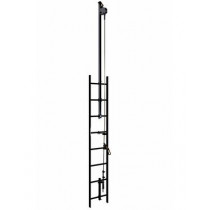
- Permanent horizontal and vertical lifelines for fixed installations with longer routes.
- Permanent horizontal lifelines including anchorage points and intermediate posts for mounting on different types of structures.
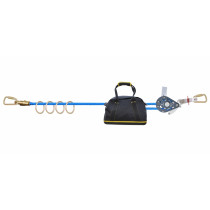
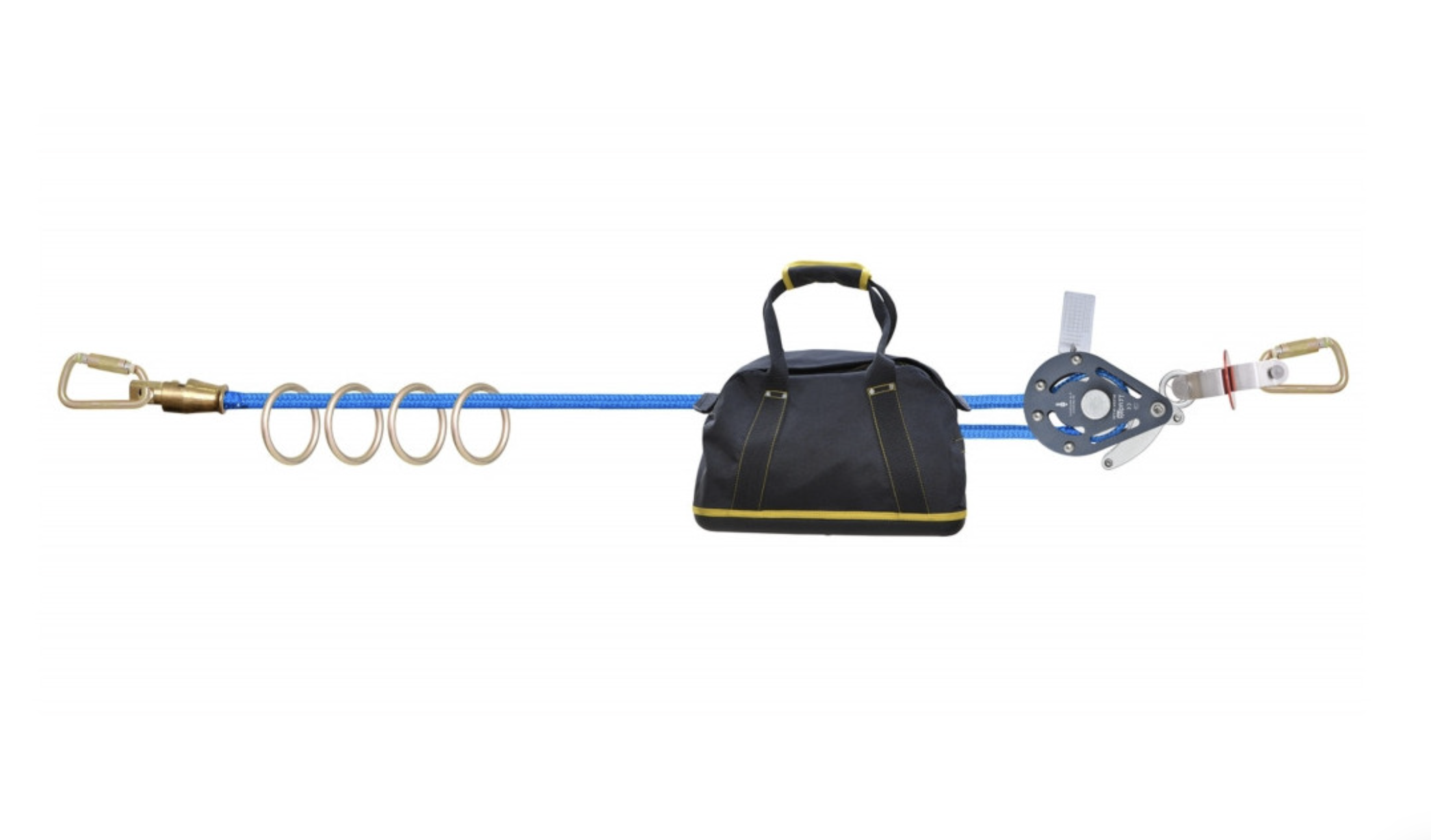
Check out our featured product: Temporary horizontal lifeline webbing for 4 users IRUDEK
FREQUENTLY ASKED QUESTIONS
1. Can I use the same lifeline for multiple workers at the same time?
Only if the manufacturer expressly certifies that number of users in accordance with CEN/TS 16415, in addition to EN 795. Exceeding the certified number invalidates the real protection of the system.
2. What is the difference between a flexible lifeline and a rigid one?
The flexible one (Class C) uses cable or webbing and requires calculating the free space due to the stretching it undergoes when stopping a fall; the rigid one (Class D) uses a rail that barely deforms, requiring less calculation but with higher installation costs.
3. Is it mandatory to calculate the free distance before installing a lifeline?
For flexible lines yes, it is mandatory; for rigid lines an estimate is acceptable, as their deformation during a fall is much less.
4. Does a horizontal lifeline replace collective protection?
It should not be used as a substitute when collective protection (railings, nets) is legally and technically feasible; it is a measure of last resort individual protection when that collective protection cannot be installed.
5. What happens if I install the line on a structure I have not verified?
It is one of the most serious and frequent errors: fixing the line to unverified anchorages invalidates any previous calculation, however resistant the structure may appear at first glance.
CHOOSE YOUR HORIZONTAL LIFELINE WITH THE CORRECT CALCULATION
A poorly dimensioned horizontal lifeline can fail precisely when it is most needed. At Sekureco.eu you will find temporary and permanent lifelines certified under EN 795, along with all the components necessary to assemble the complete system.
Visit our complete Lifelines category and choose the horizontal lifeline suitable for the number of users and the actual length of your installation.
 English GB
 Español
  Français
  Deutsch
  Italiano
  Português PT