English GB
 Español
 Français
 Deutsch
 Italiano
 Português PT





€20.56
€20.56
(TAX incl.)
€16.99 (no TAX)
€16.99 (no TAX)
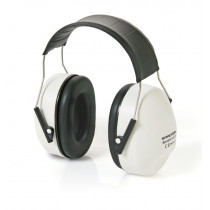
Whisper Ear Protectors/Earmuffs. Protector for noisy environments. SNR 28.45dB.
Wide range of security products for any type of industry and work
know us


Once confirmed that your workplace exceeds 85 dB(A) - the threshold that makes the use of hearing protection mandatory according to RD 286/2006, as explained in our article on mandatory hearing protection - the next question is purely practical: What specific protector do I need for my exact noise level?
This guide serves as a quick reference: based on your actual noise measurement, we indicate the recommended SNR range and the most suitable type of protector, without having to recalculate the attenuation formula each time. For the complete details on how SNR is calculated or how to choose between earmuffs and plugs according to your situation, you can consult our articles dedicated to each of those topics.
In this range, the use of hearing protection is already mandatory. A protector with SNR of 20-25 dB is usually sufficient to keep the perceived noise within the recommended range of 65-80 dB(A), without generating excessive isolation. This is the typical range for many workshops, light production lines, or technical office machinery.
A very common range in construction, carpentry, and mechanical workshops. An SNR of 25-30 dB is recommended, prioritizing comfort for prolonged use throughout the day: at this level, a poorly fitted or uncomfortable protector is as risky as not wearing one, because it increases the likelihood that the worker will remove it.
A typical level in metallurgy, light foundry, or heavy machinery continuously. Here, an SNR of 30-34 dB is advisable, and it becomes relevant to consider earmuffs attached to a helmet if the position already requires cranial protection, to avoid interference between both PPE.
Above 100 dB(A) - common in mining, blasting, airport platforms, or high-impact industrial presses - a single protector may not be sufficient even with the highest available SNR. In these cases, the combination of plugs and earmuffs at the same time is considered. It is important to note that the SNR of both devices do not add up directly: there are specific calculation methods to estimate the actual combined attenuation. As a general reference, double protection adds between 4 and 6 dB of additional effective attenuation over the most effective protector of the two, not the complete sum of both values.

In our Hearing Protectors category, you will find options for each range:
Don't wait for an inadequate protector to compromise your team's safety. At Sekureco, you will find certified hearing protectors with SNR for every noise range, from 85 dB to high-impact industrial environments.
See more hearing protection products
A protector with SNR of 25-30 dB usually keeps the perceived noise within the recommended range of 65-80 dB(A) for that level, although it is ideal to verify it with the actual measurement of your position.
2. Is it mandatory to combine earmuffs and plugs from 100 dB?
Not automatically; it depends on the specific risk assessment of the position, but it is a commonly recommended combination when a single protector does not manage to reduce the perceived noise to a safe range.
3. Why don't the SNRs of two combined protectors add up?
Because the combined attenuation is not additive: in practice, double protection adds about 4-6 dB additional over the most effective protector of the two, not the total sum of both values.
4. What happens if I choose a higher SNR than necessary for my noise level?
It can lead to overprotection: making verbal communication and the perception of alarms difficult, which in practice can lead the worker to use the protector incorrectly or to remove it.
5. Does this guide replace a real noise measurement in my company?
No. It is a quick reference guide; the actual measurement of the workplace remains the correct method to accurately determine the necessary level of protection.
> CLOTHES AND COMPLEMENTS
Please sign in first.
Sign in