The handling of electrical networks and the presence of sensitive electronic components represent in the industrial environment critical risks that demand the use of specialised Personal Protective Equipment (PPE). One of the most frequent errors in prevention departments is confusing footwear designed to insulate electricity with that intended to dissipate static charges.
Understanding European Union regulations and the technical characteristics of each footwear is vital to protect the worker's life and safeguard high-precision machinery.
THE GREAT TECHNICAL DILEMMA: INSULATING OR DISSIPATIVE (ESD)?
To correctly choose the protective footwear within our Sekureco catalogue, it is essential to distinguish the physical behaviour against current:
-
Insulating footwear (Dielectric) : its main function is to completely block the passage of electrical current through the body to the ground. It acts as a high-resistance barrier against potential contact voltages in low voltage.
-
ESD footwear (Electrostatic Discharge) : its purpose is not to block electricity, but to channel and dissipate in a controlled and safe manner the accumulation of static electricity generated by human movement, preventing sparks and discharges that could damage sensitive components.
EUROPEAN REGULATORY FRAMEWORK FOR SAFETY FOOTWEAR AND TECHNICAL SPECIFICATIONS
Compliance with CE certification standards guarantees that safety footwear has passed rigorous laboratory testing under European directives:
-
Standard EN ISO 20345 : Regulates general safety footwear, incorporating protective toe caps capable of withstanding impacts up to 200 Joules.
-
Standard EN 50321 : Specific for electrically insulating footwear for use in low voltage installations. Class 0 or Class 00 footwear is subject to voltage testing to verify the absence of current leakage.
-
Standards EN 61340-4-3 and EN ISO 20345 (ESD) : Define that the electrical resistance of dissipation must be strictly within a range between $10^5 \ \Omega$ and $10^8 \ \Omega$. A value below this limit would expose the worker to electrocution risks; a value above would prevent the correct evacuation of static charge.
Learn more about the regulatory framework in our article : The definitive guide to safety footwear: classification, standards and technical protection
HOW TO CHOOSE SAFETY FOOTWEAR ACCORDING TO INDUSTRIAL SECTOR
Maintenance of substations and electrical networks sector
In maintenance work on low voltage, distribution lines or proximity to active electrical panels, the worker requires insulating footwear. The special rubber or polyurethane sole prevents an electrical circuit from closing through the body in the event of accidental contact with an element under tension.
Electronics, automotive and cleanroom industry (EPA areas)
In spaces where microchips and printed circuit boards are handled or in atmospheres with risk of deflagration (ATEX regulations), the use of ESD footwear is mandatory. The accumulation of static charge on a worker's body can reach thousands of volts, sufficient to destroy irreparable electronic components or generate a dangerous spark.
FEATURED PRODUCTS AT SEKURECO: ESD SAFETY FOOTWEAR
Riley Fresh S1P ESD Safety Sandals LEMAITRE
View product

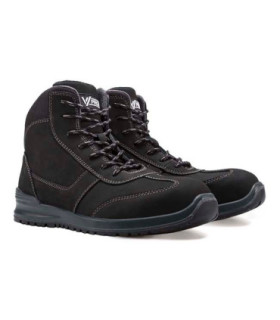
Suede Safety Shoe S3 SRC ESD WORKTEAM
View product :

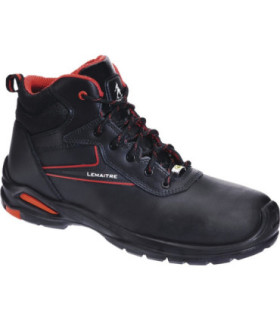
S3S ESD Safety Boots LEMAITRE
View product :

Composite Sports Shoe S1 ESD PORTWEST
View product :

FREQUENTLY ASKED QUESTIONS
Can ESD footwear be used to carry out work on active electrical installations?
No. ESD footwear is dissipative, which means it allows controlled current flow to eliminate static electricity. Therefore, it does not provide electrical insulation and should not be used in work where there is a risk of discharge through contact with the electrical network.
How can I identify if a safety shoe complies with ESD regulations?
Certified footwear visibly incorporates the ESD regulatory pictogram (usually a yellow circle with the hand and static discharge symbol) and specifies on its tongue or technical sheet the dissipative electrical resistance range in compliance with EN 61340 standard.
Do steel toe caps affect the electrical or ESD properties of the footwear?
Not necessarily. Manufacturers design modern footwear by properly isolating metal toe caps or by using non-metallic materials (such as composite or fibreglass) to ensure that the dielectric or dissipative properties of the sole are not affected by thermal or electrical bridges.
Do you need to optimise the selection of technical footwear for your workforce or require advice on another protection category at Sekureco?
Explore our specialised catalogue in safety boots and shoes or contact our technical team to resolve any questions about European standards and industrial equipment.
 English GB
 Español
  Français
  Deutsch
  Italiano
  Português PT